
Documentation
“Valuing Culture Over Time” — Tom Watkins
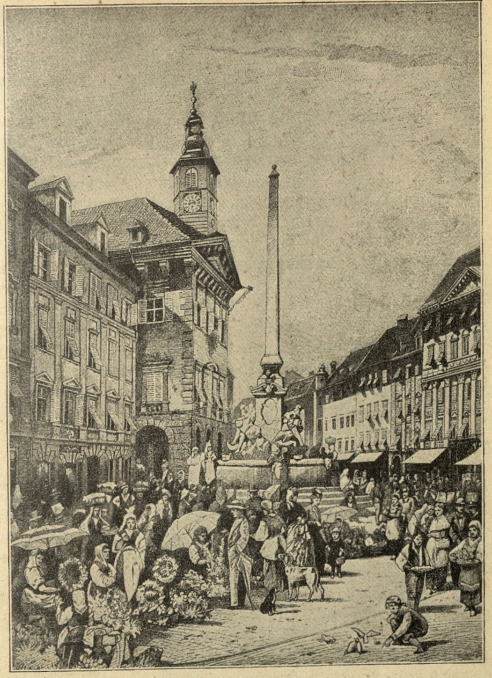
Town square with the rotovž and Robb’s fountain 1. 1870. Via: The Digital Library of Slovenia.
During the seminar led by Lars Ebert, Secretary General of Culture Action Europe, I found myself reflecting on the temporality of value. The conversation moved through policy, inclusion, advocacy, and institutional structures, but the underlying tension of how quickly something is expected to prove its worth to justify public investment resonated with me. Culture seems to operate on a different timeline than the political frameworks used to evaluate it.
One statistic Ebert estimated stood out: an 11-to-1 return on government investment in the arts in terms of economic growth. That figure is hard to ignore. Yet cultural funding remains modest, especially when compared to sectors like agriculture. The discrepancy suggests that the issue is not simply about economic evidence. It may have more to do with how value is perceived. Agriculture produces nourishment in a way that is materially immediate and politically secure. Its necessity is obvious. The arts do not always function in that register. While impact may be instantaneous, its underlying value unfolds gradually through shaping imagination, empathy, and social connection over time.
I found myself thinking about the difference between doctors and teachers. I believe that doctors are paid more in part because their value is immediately tangible. Teachers, by contrast, operate on a slower timeline. Their influence compounds across years, shaping intellectual habits, social awareness, and long-term curiosity. Culture seems closer to that second model. Its value resembles compound interest: often opaque at first, but transformative over time.
The State of Culture report notes that cultural advocacy frequently relies on instrumental arguments—economic growth, innovation, wellbeing—because those categories are legible within policy discourse (Polivtseva 2024). At the same time, the report acknowledges the risks of over-instrumentalization. When cultural institutions are forced to justify themselves primarily through short-term metrics, something about their longer, relational effects is reduced (Polivtseva 2024). Policymaking tends to privilege what can be quantified quickly, even if democratic life depends on processes that unfold more slowly.
This temporal tension becomes even more visible in discussions of inclusion. Funding structures do more than distribute resources; they determine whose cultural work is sustained across time. If culture functions like compound interest, then access to funding shapes who can generate long-term value in the first place. Exclusion is therefore not only a moral concern but a structural one. The Porto Santo Charter calls for broader participation in cultural decision-making and proposes tools such as a Cultural Democracy Index to measure engagement beyond narrow economic indicators (Portuguese Republic 2021). In doing so, it reframes value itself, shifting attention from immediate output to sustained participation. If cultural democracy means anything, it may require rethinking not only how much we fund the arts, but how we understand the time it takes for their value to emerge.
References
Polivtseva, Elena. 2024. State of Culture. Edited by Lars Ebert, Natalie Giorgadze, and Luiza Moroz. Culture Action Europe. https://cultureactioneurope.org/wp-content/uploads/2024/10/State-of-Culture-Report_final_version.pdf.
Portuguese Republic. 2021. Porto Santo Charter: Culture and the Promotion of Democracy: Towards a European Cultural Citizenship. https://portosantocharter.eu/wp-content/uploads/2025/09/VF_ING_CPS_AD.pdf.