

Documentation
[TiM Recap] “Theater, Moon Studies, and Interplanetary Entanglements” – Vivian Appler (UGA), Felipe Cervera (UCLA), Marjolijn van Heemstra, Xiao-Shan Yap (UU), and Maaike Bleeker (UU)
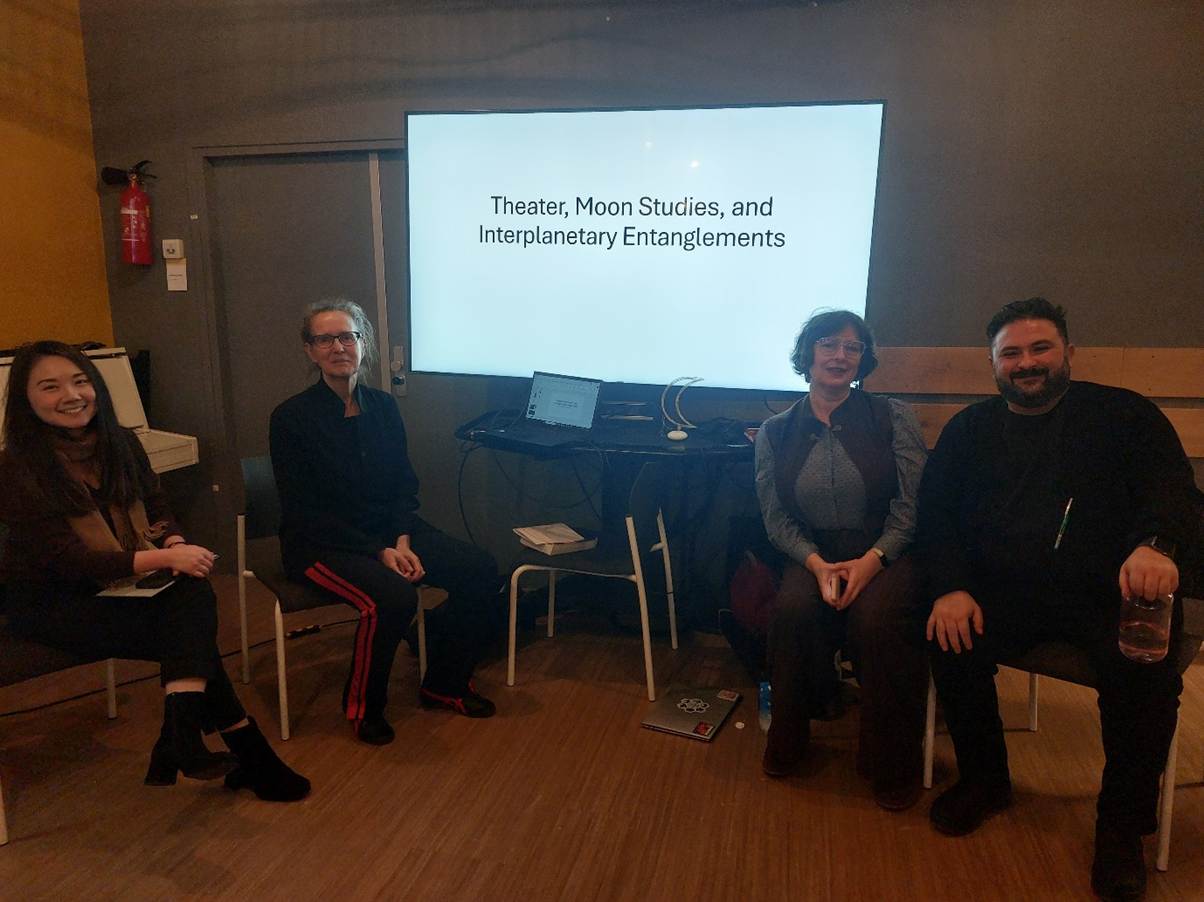
What does it mean to expand theatre studies into space? With this provocation, Maaike Bleeker (Utrecht University) initiated an interdisciplinary and explorative conversation with Felipe Cervera (UCLA), Vivian Appler (University of Georgia), and Xiao-Shan Yap (Utrecht University). The conversation began with the speakers’ individual presentations of their work, followed by an open-floor discussion among the speakers and audience. The session traced connections and linkages between theatre, performance, the history of space exploration and the humanities to rethink how humans imagine, access, and govern space.
Space humanities and theatrical entry point (Felipe Cervera)
According to Cervera, space humanities begin where theatre studies end. There are several assumptions in space and performance studies that exclude the exploration of theatre in space studies, and vice versa. In theatre studies, there is a bias against non-body existence which assumes that you need to be in space to study space, despite very limited access to space. Although we might not be in space, our earthly existence is no less entangled with the extraterritorial space. Firstly, space is co-present with the Earth, and humans and other earthly lives leave traces in this habitat. Secondly, space technology can be used for artistic and theatrical purposes, which visibilize humans’ connections with extraterrestrial things.
Historical erasure and Americans on the moon (Vivian Appler)
Appler approached minority representation in the history and futures of space exploration through archival and artistic research. A historical lacuna exists in space exploration as there was a deliberate erasure of women and underrepresented minorities in the sciences, which remain Eurocentrically and hierarchically defined. On the contrary, plays and performances can help us rethink access to science and the moon. For example, the women’s bodies in the play The Rocket Men (by Crystal Skillman) represent underrepresented minorities and women. The play addresses the history of erasure by staging professionalisation in space exploration and showing how that is embodied. In the current political dynamic, it is important to think about the history of erasure from a forward-looking perspective to consider the prospective future.
Planetary stewardship in view of Earth-Space sustainability (Xiao-Shan Yap)
The PlanetStewards Project, led by Yap, advocates sustainable and ethical access to space. Driven by an extractivist view of space – that whatever is in outer space is to be internalised, commercial players are sending more things into space, building larger rockets, and creating more space debris. By advocating Earth-Space sustainability, the space narrative becomes more inclusive, as what happens beyond the boundary of the Earth is also included in our sustainability discussion. Contrary to an ‘Outer Space’ perspective, an Earth-Space perspective considers the following: Earth is situated in space; there are terrestrial-celestial relations and natural intrinsic rights; and, sustainability and justice are multi-planetary.
Epistemology and instruments (Maaike Bleeker)
What is being performed in space? How do devices and instruments affect our vision of space? How do humans see themselves in space? The exploration of space begins with a desire to imagine what is out there, and astronomy does that through different technologies. These technologies moved and transformed over time. In the beginning, they were designed for human senses, but later, advancements in devices addressed non-human, alternative sensing. Technologies are performed according to our epistemological frames, and we can rethink ourselves through rethinking humans’ partnerships with technology – and thus look back at the history of knowledge production. For example, astronomer François Arago’s reflection on instruments and his knowledge shows that interference is a necessary condition of our access of knowledge. On the other hand, an instrument that invokes multiple spectator positions, for example, an orrery of the solar system, invites observers to observe from the outside while imagining living from within.
Open discussion
It is noticed that there is a shift in thinking from critical humanities toward posthumanism and the non-human perspective, and new vocabularies are needed to support critical reflection of space. Humanities scholars’ research on space should go beyond speculative imagination alone and move toward rigorous and material modes of study. Also, while an instrumental, utilitarian approach toward space is very prevalent, the non-use value of space –that there is intrinsic worth of space and its resources without any human extraction and consumption, can counter economical and colonial use of space.
References
Xiao-Shan Yap, Blake Harvey, Erin Jones, et al. n.d. “Planetary Stewardship In View of Earth-Space Sustainability.” PLANETSTEWARDS. Accessed January 15, 2026. https://www.planetstewards.eu.