Documentation
[TiM Recap] “Culture for Democracy, Democracy for Culture”- Lars Ebert (Culture Action Europe) moderated by Toine Minnaert
by Agata Kok
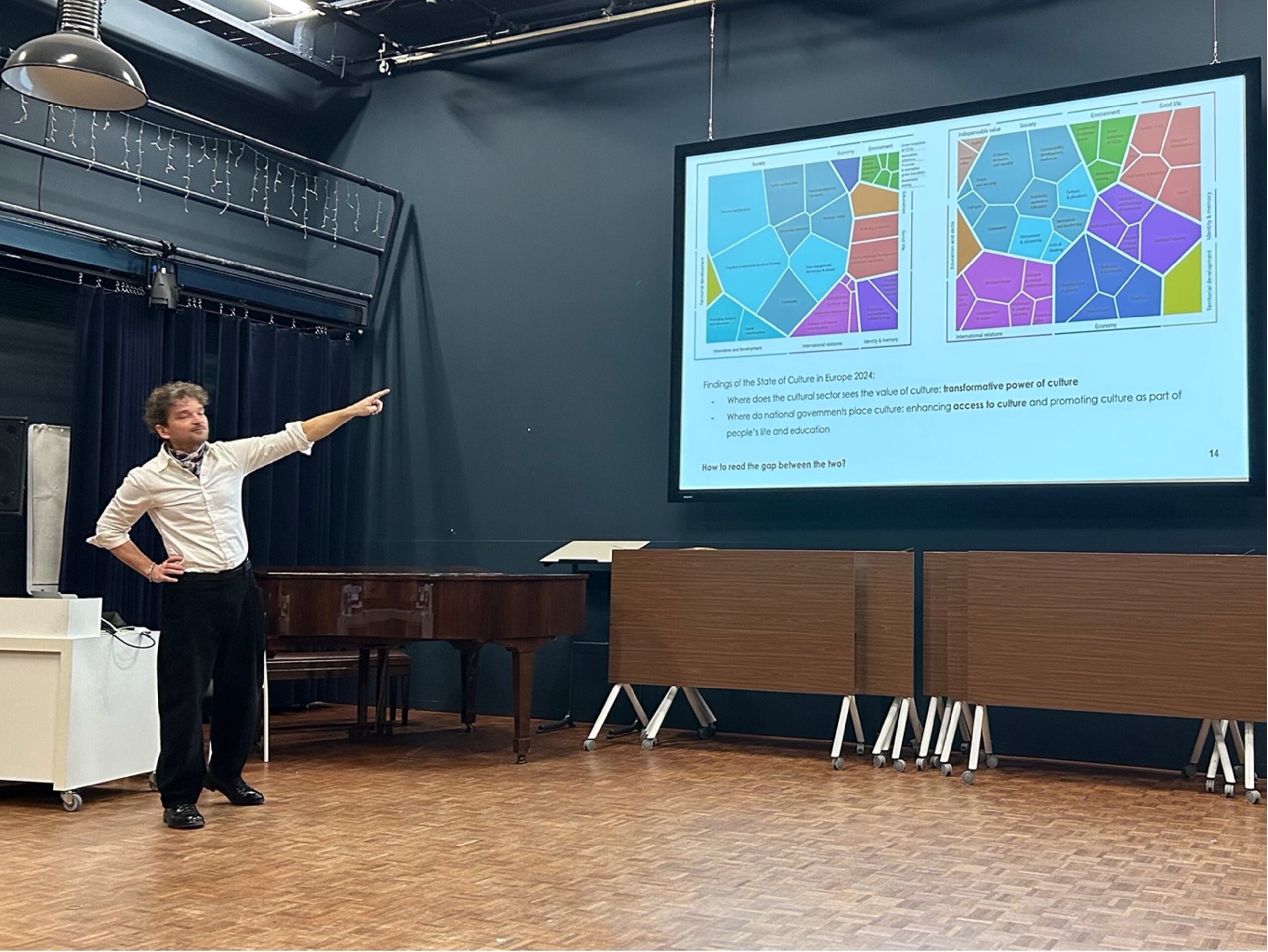
As Secretary General of Culture Action Europe, Lars Ebert advocates for strong cultural policies in Europe through cultural democracy. During the lecture moderated by Toine Minnaert, Lars introduced Culture Action Europe, which is an organisation that brings together over 300 members from 39 counties, including various cultural networks, organisations, artists, activists and policymakers. During the seminar, Lars invited the audience to ponder the question “How to be many?” (Ebert 2026, 31) – and look for answers amidst current crises of democracy in Europe. Positioning CAE as “the political voice of the cultural sector in Europe,” Ebert (2026, 3) outlined its dual role: engaging policymakers at the European level while also fostering dialogue within the sector itself, highlighting the need to find a shared language within such a jungle of entanglements. Ebert invited the audience to reflect on how the cultural sector can mobilise collectively while remaining diverse and internally critical, arguing for culture not as an accessory to democracy but its structural condition, “a foundational public good” (Ebert 2026, 3). Yet at the European level, culture is often treated as a transversal “vector” rather than a sector in its own right. Although data show that €1 invested in culture can generate €11 in GDP, culture still accounts for only around 0.2% of the EU budget. Political strategy, Ebert stressed, is not only about arguments or data but about building alliances and understanding institutional hierarchies.
The discussion also addressed the growing instrumentalisation of culture. Referring to the State of Culture in Europe 2024 report, Ebert noted that in times of crisis and declining political trust, the sector often adopts externally imposed narratives, emphasising entrepreneurship, wellbeing, or measurable impact, rather than defending culture as a fundamental democratic right. This has created a gap between how the sector sees itself and how it is politically framed (for example, through heritage, tourism, or national value). One of the report’s key observations: “Culture can save democracy, but only if it is democratic itself” (Ebert 2026, 17), brought the discussion to a crucial paradigm shift: moving from the democratisation of culture, primarily concerned with widening access to existing cultural institutions, and going further towards cultural democracy. While democratisation of culture focuses on distributing established cultural products to broader audiences, cultural democracy calls for co-creation, shared authorship, and the fostering of spaces held in common.
In this context, the Porto Santo Charter was discussed as a key reference document. The Charter outlines cultural democracy as both a fundamental right and a shared responsibility, emphasising the right and capacity of everyone to access, participate in, create, and shape culture as an essential dimension of democratic life. The example of KAAI Theatre Brussels illustrated how such principles can be explored in practice. The question, however, remains whether such models are replicable or whether they must remain context-specific and tailor-made, requiring time, trust, and a willingness to embrace vulnerability and uncertainty. The lecture remained dynamic and responsive. Audience interventions shaped the direction of the conversation, particularly around the complexities of cultural budgeting and EU-level decision-making. By clarifying how funding frameworks operate the discussion became more tangible and accessible. This interactive format made the session engaging and participatory, embodying the very principles it advocated. As introduced by the moderator, the seminar became an exercise in using our collective brainpower to articulate the importance of art and culture amid democratic backsliding, populist discourse, and the growing instrumentalisation of the sector.
References
Ebert, Lars. “Culture for Democracy, Democracy for Culture.” Transmission in Motion Seminar at Grote Zaal, Muntstraat 2A, February 18, 2026.