

Documentation
“This Is Not Fiction” – Agata Kok
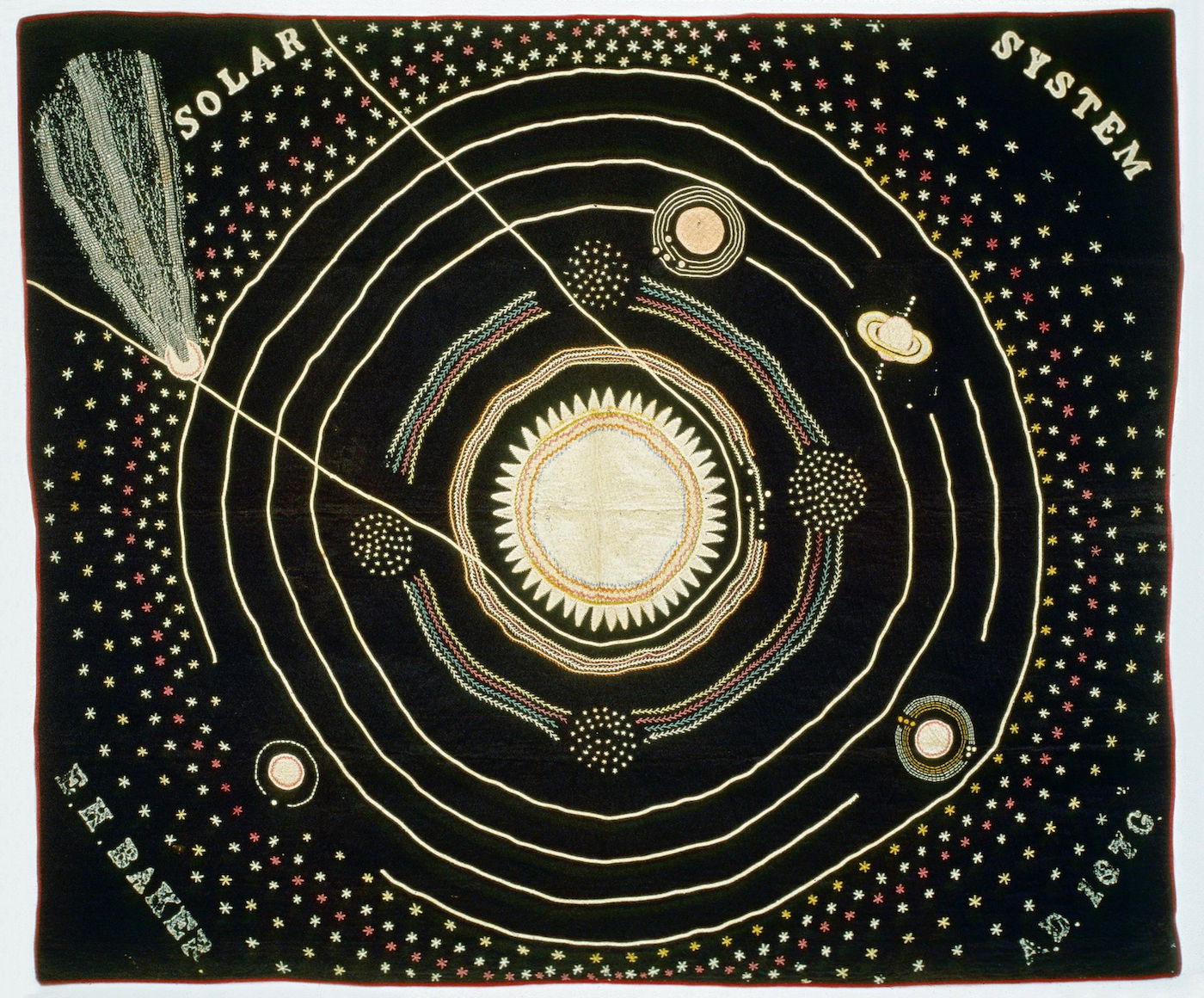
Harding Baker, Ellen. 1876–ca. 1883. Solar System. Quilt. Via: The Public Domain Image Archive. Source: The Smithsonian Library.
Treating space as an object of inquiry within the Humanities may initially appear abstract (not to say absurd) – particularly when the focus shifts from science-fiction representations toward outer space itself: that is, toward our concrete interactions with and entanglements in the universe beyond Earth. However, as has been widely demonstrated, performances and performative actions have historically functioned as central instruments in the representation and politicization of space discovery and exploration, thereby situating space as an extension of earthly social, cultural, and political affairs (Cervera 2016). From the Space Race between the United States and the Soviet Union, space exploration has operated as a site of social imagination and entangled meanings. It is shaped through interplays between collective hopes, ideological projections, and performances of dominance. As Mai’a K. Davis Cross notes, “despite many governmental efforts to militarize space over the past 70 years, on the whole, non-state actors have ensured that space has been a highly cooperative realm of human interaction, even during the height of the Cold War” (Cross 2019). More than fifty years after the first human set foot on the Moon, images of outer space tend to persist in the public consciousness as belonging to another historical moment. Meanwhile, current developments in space exploration are both massive in scale and rapidly accelerating, driven by new commercial actors and renewed global competition. However, contemporary space exploration has increasingly shifted toward commercialized, globalized, and privately driven displays of technological power – often reduced to spectacles of billionaire entertainment rather than scientific endeavor, as exemplified by celebrity spaceflights such as the much-publicized sending of Katy Perry into space (Molloy and Gill 2025).
In this context, the question to be posed is perhaps no longer “what is the place of the Humanities in space research?” but rather “what is the place of the Humanities within space research now?” The speakers at the seminar underscored the urgency of developing new vocabularies and methodological approaches for engaging with space through performance and critical theory. On an individual level, we are already materially and affectively entangled with extraterrestrial infrastructures through the use of satellite-based technologies such as GPS and telecommunications. Simultaneously, the absence of effective governance frameworks—made visible through the exponential accumulation of space debris—reveals the extent to which space has become a site of unregulated extraction and exploitation (Yap, Heiberg, and Truffer 2023). Under late capitalism, these conversations are frequently driven by logics of profit maximization for a limited elite, rather than by collective imaginaries or shared responsibilities. To intervene meaningfully, it is also necessary to confront the historical foundations of space exploration: its colonial imaginaries, extractivist logics, and narratives of conquest. Without addressing these legacies, contemporary engagements risk reproducing the same structures of exclusion and exploitation beyond Earth.
As stated by the Performance Studies Space Programme convened by Maaike Bleeker and Felipe Cervera, the task is “to articulate the paradigms and criticalities needed to deal with the universe and our place in it” (Bleeker and Cervera 2025). Space can no longer be approached solely as a speculative site for imagining alternative futures. These futures are happening now. Consequently, it is crucial to insert Humanities in the conversation on space – or start that conversation if necessary – unless we are prepared to be displaced from it altogether.
References
Bleeker, Maaike, and Felipe Cervera. 2025. “Performance Studies Space Programme – LASALLE.” LASALLE. August 22, 2025. https://www.lasalle.edu.sg/research_areas/performance-studies-space-programme/.
Cervera, Felipe. 2016. “Astroaesthetics: Performance and the Rise of Interplanetary Culture.” Theatre Research International 41 (3): 258–75. https://doi.org/10.1017/s0307883316000353.
Cross, Mai’a K. Davis. 2019. “The Social Construction of the Space Race: Then and Now.” International Affairs95 (6): 1403–21. https://doi.org/10.1093/ia/iiz190.