

Documentation
The Event of Redness – Nikita Chistov
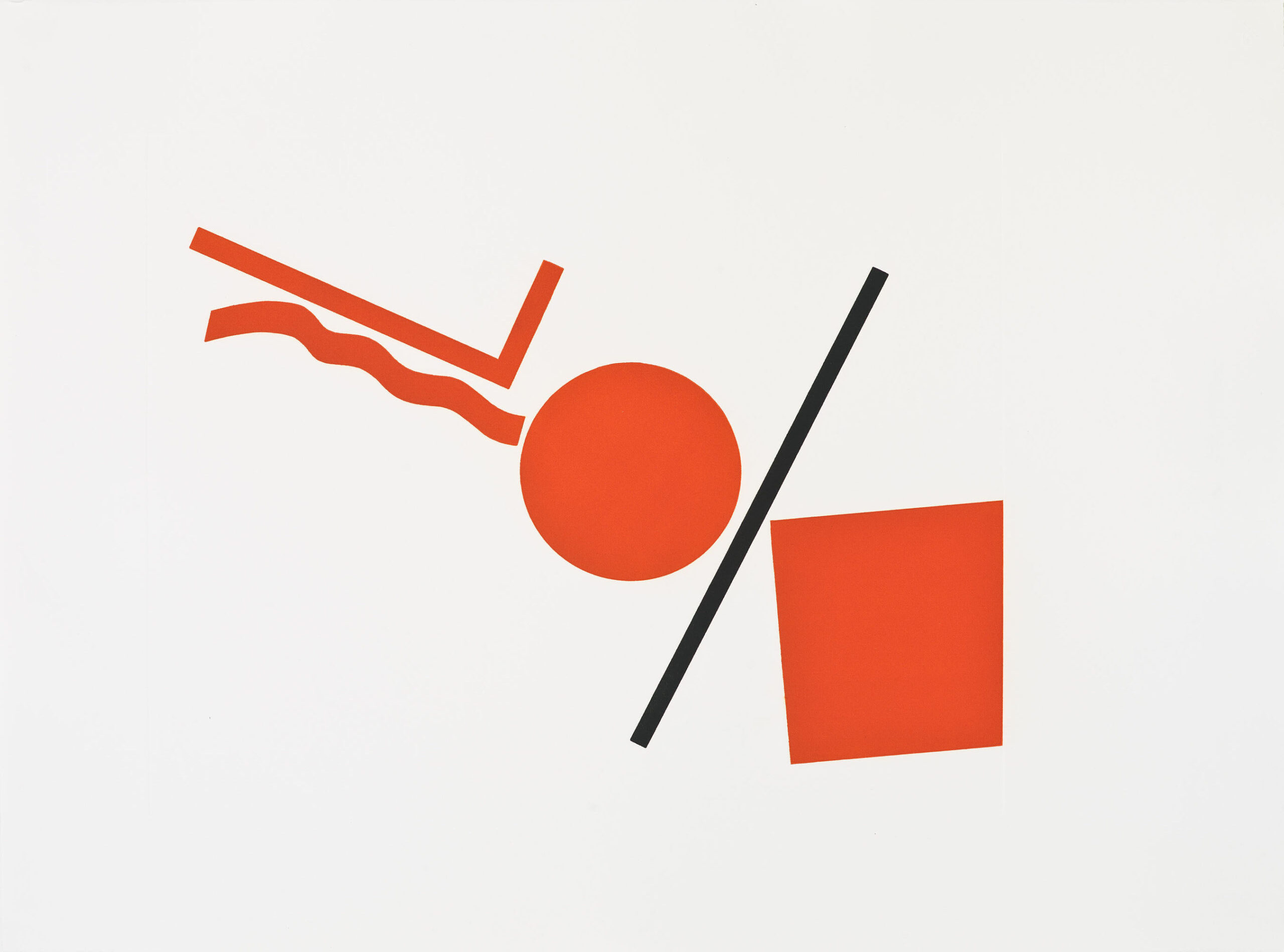
Stephen Antonakos. Black and Red, 1987. Via: Europeana. Source: Metropolitan Organisation of Museums of Visual Arts of Thessaloniki – MOMus, Greece. Edit: Image rotated of 90° left.
What is a clown nose? Is it a nose or, rather, something that conceals your nose?
Does this concealment make you a clown?
My second coffee of the day has just kicked in, and I am ready to “unpack” the small spongy sphere in front of me. Soon enough, I am reminded of Dumit’s remark: “Coffee is not enough, alas” (2014, 345). Physiological wakefulness won’t do. What Haraway and Deleuze – the key thinkers in this installment of Transmission in Motion – want me to do is to wake up to the alternative narratives present in this small mass of red. That is, to de-automatize my perception, Shklovsky style, and tap into the greater field of possibility. Somehow, I need to overcome “that most comfortable of epistemic objects, a cliché” (Dumit 2014, 347).
Can I decouple the clown nose from clowns and noses? Can I experience it differently, despite its name and histories of use?
I pick up the ball and start squeezing it gently. I am trying to focus on the object’s qualities to experience “the luminousness of the thing in itself” (Sontag 1966, 10). Softness reveals itself. But also squishiness. A certain flexibility. Resilience. When I squeeze it, the ball shrinks in my hand, but then always expands to its original size. There is a lightness to it, too; it hardly weighs anything. And of course, there are the classic redness and roundness. But also a kind of inevitable centrality revealed when putting it on the nose: your face immediately becomes organized around a red, perfectly round bull’s-eye.
Is there an initial moment when it is not a clown nose at all but rather an event of resilience, lightness, redness, roundness…?
I cannot help but think about Heidegger and Gadamer’s ontological hermeneutics, the study of understanding itself. Rather than seeing the clown nose in terms of its uses and functions, ontological hermeneutics is interested in the initial event of experience: that which occurs “prior to any technical or epistemological conception of understanding or knowledge” (McAuliffe 2023, 99). The study concerns itself with the ways that clown noses’ being-in-the-world happens to us, how it takes hold of our senses before we can make further epistemological sense of it.
How much can I de-clown and de-nose…? How much wakefulness is possible?
In my hands, the object starts to shed its meanings and unfold into a miniature playground of potentialities and becomings. It is something I can squeeze and then release slowly, focusing on the gradual restoration of shape and volume under my fingers. If I choose to, I can use it as a way of regulating my nervous system or learning more about foam. I can toss it up in the air, see how it bounces against my body, register its weight. If I choose to, I can designate it as a juggling ball and find my way back to clowns. For now, though, I choose to simply play and explore the possibilities. Now I am awake.
References
Dumit, Joseph. 2014. “Writing the Implosion: Teaching the World One Thing at a Time.” Cultural Anthropology 29(2): 344–62. https://doi.org/10.14506/ca29.2.09.
McAuliffe, Sam. 2023. Improvisation in Music and Philosophical Hermeneutics. Bloomsbury. https://www.bloomsbury.com/uk/improvisation-in-music-and-philosophical-hermeneutics-9781350338029/.
Sontag, Susan. 1966. “Against Interpretation.” In Against Interpretation and Other Essays. Penguin.