
Events
“Humour, Truth-telling, and Situated Knowledges” – Dick Zijp (Utrecht University)
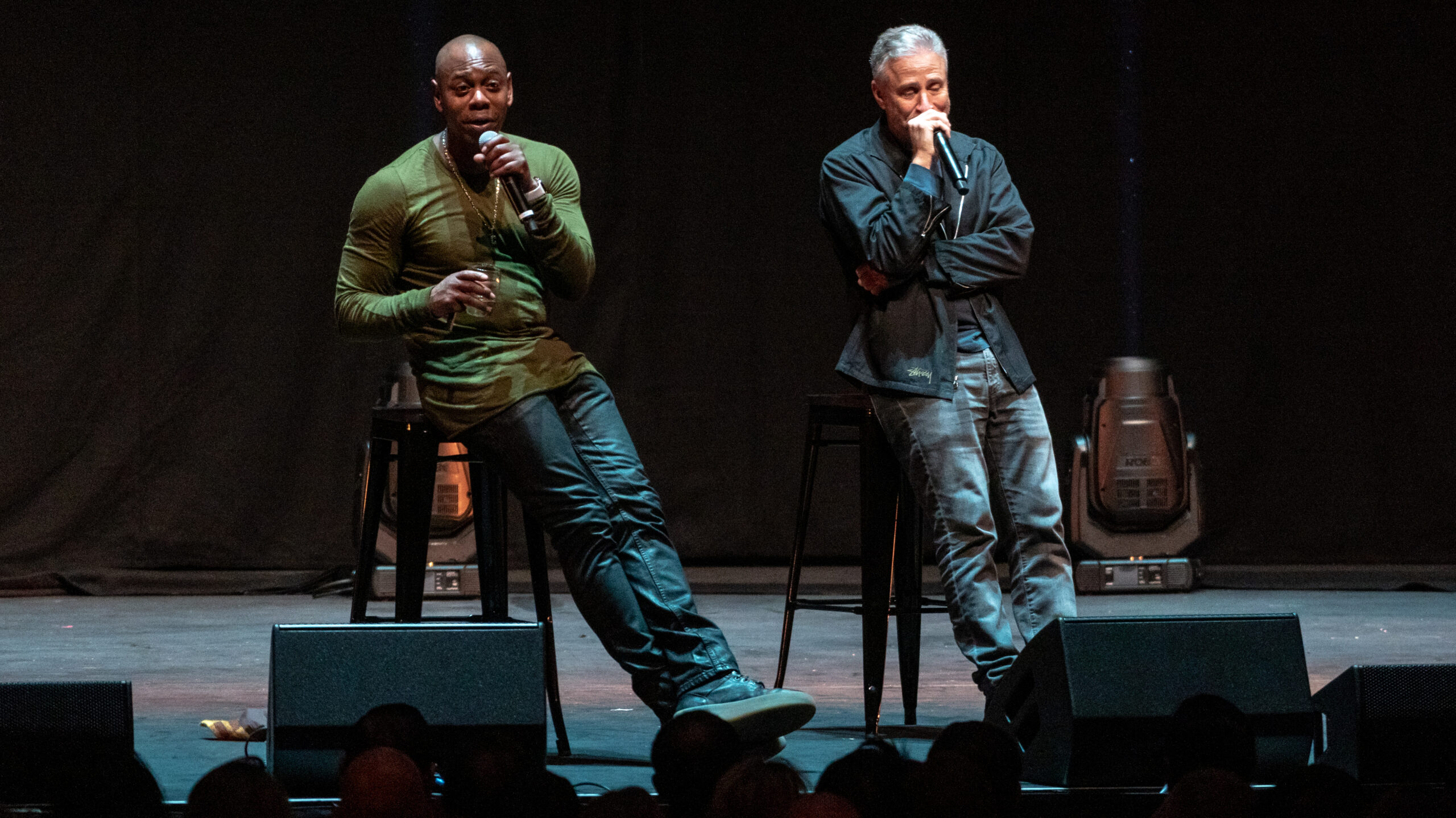
Dave Chappelle with Jon Stewart performing at Royal Albert Hall in 2018. Via: Wikimedia Commons. Source: Flicker Raph_PH. CC BY 2.0.

While comedians are often described as “truth-tellers,” the relationship between comedy and truth-telling is typically taken for granted. But what do we mean when we say that comedians “speak truth”? How can comedic speech be truthful? What “truth regimes,” to borrow a term from Michel Foucault, govern their work? In a post-truth world in which politicians increasingly act like comedians—as demonstrated by the rise of clown-politicians such as Donald Trump—and satirical late-night comedians increasingly behave like investigative journalists, such questions have become particularly urgent.
The traditional understanding of comedians as truth-tellers suggests that they speak from a marginal position and challenge a powerful centre. This idea of “speaking truth to power” seems to position comedians as anti-institutional: as rebels who tear down oppressive structures and institutions rather than caring for existing ones or building new ones. However, as Nicholas Holm (2018, 41) reminds us, humour is “never just anarchic negation, but rather also assumes a set of beliefs and structures against which incongruity can be perceived and ridicule mobilised.”
In this talk, Dick Zijp will draw on recent work in critical comedy studies (Weaver and Lockyer 2025) and Donna Haraway’s (1988) notion of “situated knowledges” to argue for a conception of truth-telling that attends to the sociocultural embeddedness of the comedian. As a case study, he will examine the work of two differently situated comedians: the white Dutch comedian Theo Maassen and the Black American comedian Dave Chappelle. Both have grappled with the question of how to speak truth through comedy, especially when poking fun at social and cultural groups they do not fully know or understand – something they simultaneously admit and downplay in their work.
 Dr. Dick Zijp is an Assistant Professor at the Department of Media and Culture Studies of Utrecht University. He teaches in the BA Media and Culture, the MA Contemporary Theatre, Dance and Dramaturgy, and the MA Arts and Society. He has a background in theatre and performance studies, philosophy, and cultural studies. His research explores the politics and aesthetics of humour and comedy in the late twentieth and early twenty-first centuries. He has published extensively on Dutch cabaret, stand-up comedy, and the role of humour in the public sphere. Recently, he has developed an interest in humour scandals. His work has appeared in, among others, the European Journal of Cultural Studies, Comedy Studies, and the European Journal of Humour Research. Zijp is currently preparing a monograph on the politics of Dutch cabaret and stand-up comedy for Palgrave. In addition to his academic work, he is active as a freelance comedy critic, and regularly engages in public debate.
Suggested Readings
Weaver, Simon and Sharon Lockyer. 2025. “Intersectionality and the Construction of Humour in Contemporary Stand-up Comedy.” European Journal of Cultural Studies 28(6): 1551-1569. https://doi.org/10.1177/13675494241294156.
Haraway, Donna. 1988. “Situated Knowledges: The Science Question in Feminism and the Privilege of Partial Perspective.” Feminist Studies 14(3): 575-599. https://doi.org/10.2307/3178066.
You can register for this seminar here.
This session is part of the Transmission in Motion seminar (2025-2026): “Navigating Entanglements.”
To stay updated with more seminar sessions, please subscribe to our newsletter.