
Documentation
“How to Be Many: Democratic Practice and Institutional Plurality” — Jilke van der Kolk
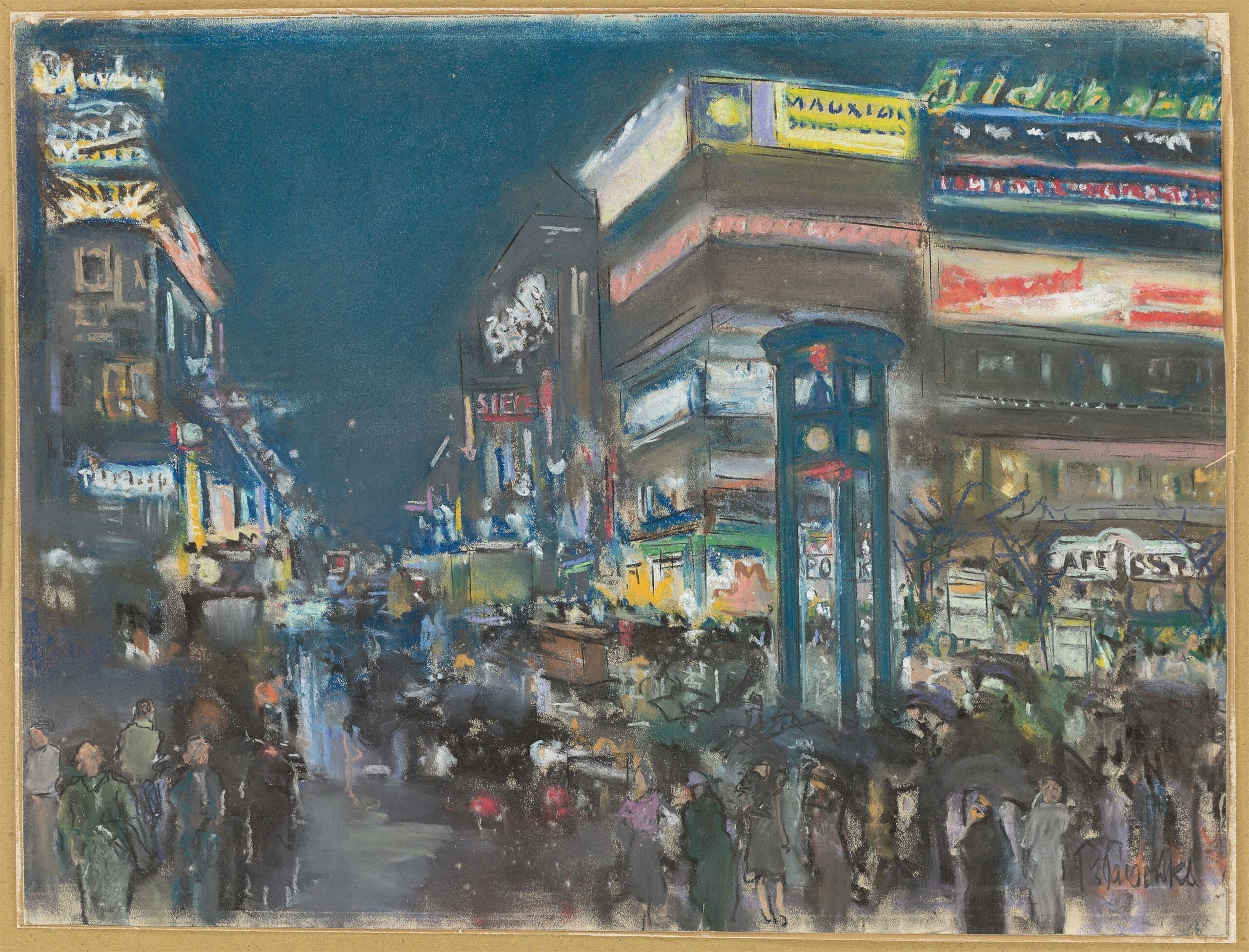
Paul Paeschke, 1929. Potsdamer Platz by Night. Via Wikimedia Commons.

How can we be many? A seemingly simple question, yet it became the red thread of the latest Transmission in Motion seminar “Culture for Democracy, Democracy for Culture”. Lars Ebert returned to it insistently, using it as an opening within the increasingly narrow space the cultural sector seems to occupy. How can the cultural sector remain plural and still articulate common goals within a political landscape that appears to demand coherence? This question resonates beyond the seminar context. Fragmentation has become a defining condition of both academia and the cultural field. Institutions coexist, yet rarely do they consolidate into a single voice. A tension emerges when this plurality encounters a political framework that privileges measurability and unified representation.
This friction becomes visible in the distinction between participation and access. The cultural field exists by the grace of its content, by what it sets in motion. Yet within policy discourse, participation is often reduced to access. Attention shifts toward how many tickets have been sold and what audiences have been reached. Meanwhile, the sector itself insists on things such as quality, artistic freedom, autonomy, and the fragile conditions under which work can emerge. This results in a structural translation problem. Culture is repeatedly asked to justify itself in metrics that do not capture its primary operations. Even when persuasive economic figures are presented, they rarely shift priorities. Politics and culture imagine value differently. Where one seeks calculable return, the other operates through aesthetic, and long-term transformations that are not designed for immediate quantification.
Another distinction between the two lies within the concept of time. Political leadership functions within compressed electoral cycles. Visibility and voter confidence must be secured quickly. Institutions, by contrast, unfold over longer durations. They carry histories and futures that exceed a single mandate. And policymakers may possess continuity but lack decisive authority, while politicians hold authority but operate under temporal pressure. This asymmetry sharpens the divergence between measurable impact and sustained cultural processes. It also complicates the possibility of speaking “as many.” Under temporal pressure, plurality appears inefficient, even politically risky.
This consequence is a narrowing of imagination. Culture is frequently recognized as a guardian of the past. It can be seen as a repository of memory and heritage. Yet, it is less often acknowledged as a catalyst of the future. When policy frameworks are dominated by metrics, the horizon of possibility contracts. The challenge may lie in a diminished capacity to imagine democracy itself as a cultural practice.
How, then, can we be many? Perhaps the question does not require the consolidation of voices into coherence. Plurality need not be resolved in order to function. To be many may mean to recognize fragmentation as a condition to be structured rather than overcome. It may require designing frameworks in which distinct voices can remain distinct while still oriented toward common concerns. Democracy, in this sense, would have to be rehearsed within culture itself.