
Documentation
“BECOMING-HOUSE” — Nikita Chistov
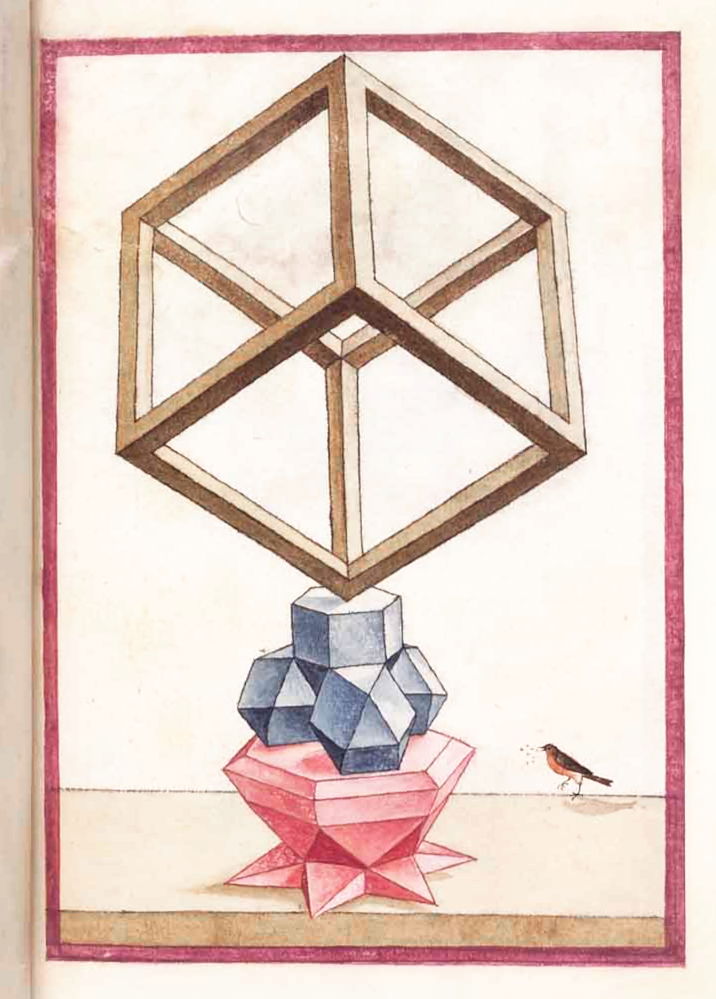
Collection of geometric and perspective drawings. Via: Public Domain Image Archive. Source: Herzog August Bibliothek.
Anne Breure is interested in the new. On the page of Theater Utrecht, where Breure has served as an artistic director since 2022, one finds her statement that “The power of theatre is that we constantly imagine a new world. Now we have a home where we continuously create worlds and ideas side by side. Worlds that meet, that can contradict and enrich each other. A home as an artistic hub, headquarters, beehive or whatever you want to call it” (Theater Utrecht nd)
Breure continuously returns to these and other spatial metaphors in the third installment of Transmission in Motion. That of the house or home takes centre stage. Speaking of her previous project, Veem Huis voor Performance in Amsterdam, Breure underscores its huis nature: it is no theatre but, indeed, a house – an open space for engineering new ways of thinking, being, and institutionalizing.
Gilles Deleuze and Felix Guattari are also interested in the new. In A Thousand Plateaus, the philosopher duo famously differentiates between arborescent and rhizomatic thinking. Arborescent or tree-like thinking is linear, predictable, “a marvel of stable, hierarchical organization” (Adkins 2015, 23). It works through representation, referring to and re-performing pre-existing forms. Rhizomatic thinking, on the other hand, “do[es] not function according to representation. Nothing in a rhizome represents something else. There are only connections” (Adkins 2015, 28). Deleuze and Guattari (D&G) associate such a hierarchy-less, connection-based space with the production of the new. As contrasting elements connect into so-called assemblages, a mutual transformation may occur, offering a line of flight out of the rigidity of arborescence (Adkins 2015, 24-28).
In the language of D&G, both Veem Huis and Teater Utrecht perform a becoming-house. Breure steers both institutions away from the well-trodden path of theatre and all that it represents traditionally. In fact, she refuses to join forces with Stadsschouwburg Utrecht – an emblem of arborescence – to engage with a more rhizomatic form of institutionalization. What interests her is not hierarchies but meeting spaces eluding the grasp of representation, where “worlds and ideas” can exist “side by side”, as well as “contradict and enrich each other”, without merging into a stable construct (Theater Utrecht nd ).
Granted, a house is not a new idea. It isn’t free from the arborescent and may very well carry with it certain hierarchical ways of thinking. However, as D&G remind us, “every assemblage will have rhizomatic and arborescent tendencies […] Furthermore, as a methodology the task is to create something new by focusing on the rhizomatic aspects of an assemblage” (Adkins 2015, 31). As long as the house remains an open performative framework with focus on the rhizomatic, the new is very much possible. Fluctuating between becoming-house, becoming-beehive, and becoming-ecology, Breure’s theatres chart their unique paths of de- and re-institutionalization.
References
Adkins, Brent. 2015. “Rhizome.” In Deleuze and Guattari’s A Thousand Plateaus: A Critical Introduction and Guide, 22–33. Edinburgh University Press. https://www.jstor.org/stable/10.3366/j.ctt1g0b18p.
Theater Utrecht. nd. “Center for Performing Arts.” In Theater Utrecht. Accessed January 30, 2026. https://www.theaterutrecht.nl/en/centre-for-performing-arts.