
Documentation
“A Messy Race to Ou(te)r Space” – Thorn Austin
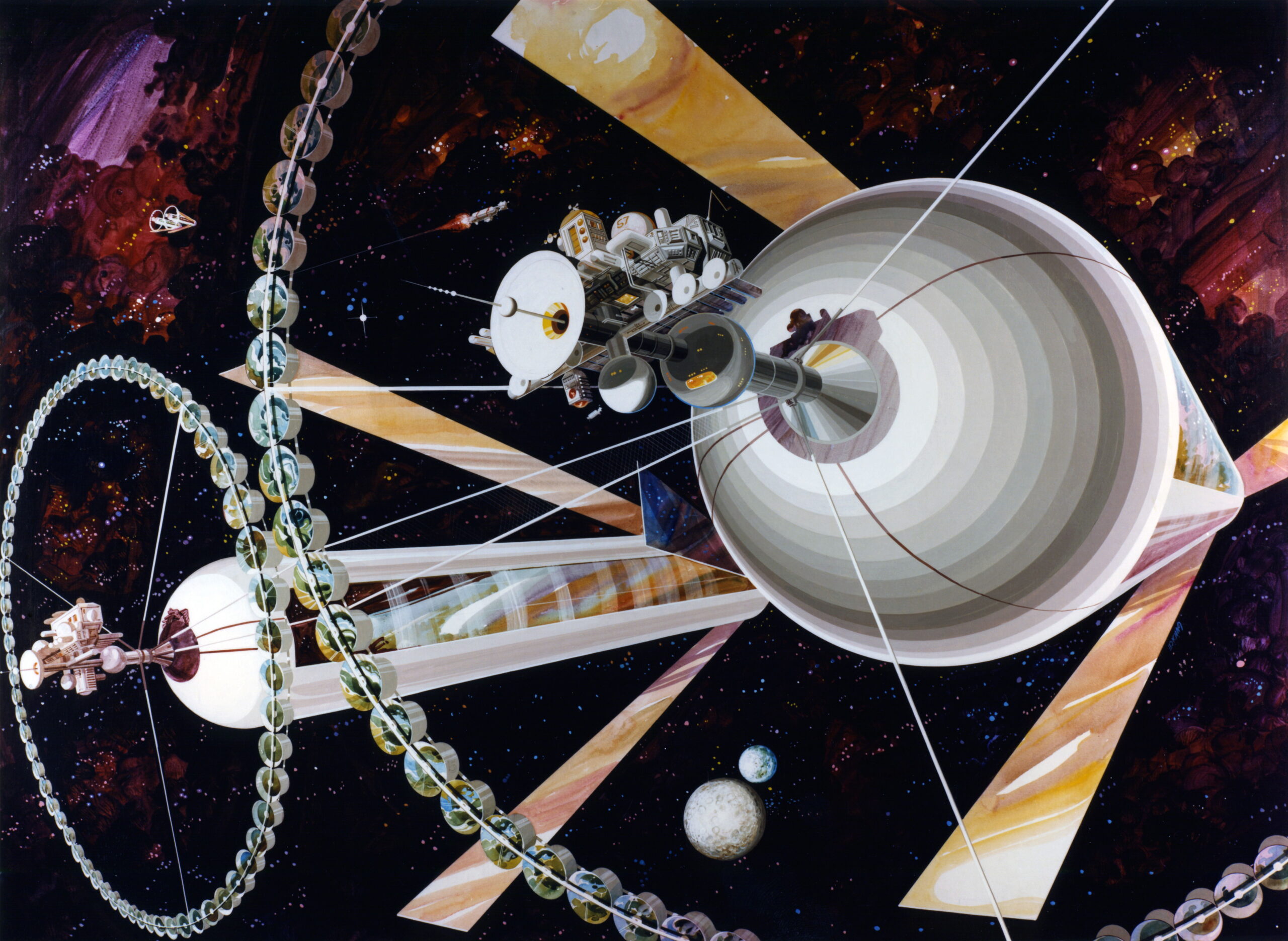
Illustration by Rick Guidice of a double cylinder colony, 1970s. Via: Public Domain Image Archive. Source: Nasa on The Commons.
When we hear the word extraterrestrial, we often think of aliens, visitors from another planet, another galaxy, another world. But as humans explore deeper into the vastness of space the question arises, are we not, to some extent, also extraterrestrial? Thinking about ourselves as extraterrestrial beings dissolves the false separation between Earth and outer space and opens many new doors in thinking about human heritage and Earth as a vital part of a vast universal ecosystem. Indeed, is it even right to call “outer space” what is so deeply entangled with our space? When the moon and its gravity affect ocean tides and the sun can emit solar flares affecting human technology, the term “outer” appears misleading, a subtle form of linguistic othering that allows many to ignore what humans are doing in space and the effects that may have in the long term.
From when humans started exploring space, we have been leaving behind quite a mess. Space debris refers to any piece of machinery or waste left by humans in space, and in more than seventy years of space exploration we have left a lot of it. I have noticed that general articles, from websites such as Britannica, are more concerned about the risks space debris poses to space exploration, satellite collisions and humans “uses of outer space” while ignoring the environmental questions or concerns that specialized articles focus on (“Space Debris | Facts, Removal, & Examples | Britannica” 2025). There are many environmental aspects of space debris such as spacecraft emissions in the stratosphere, the potential to alter atmospheric chemistry, threats to ground safety and marine ecosystems and the loss of “the quietness of the sky” (United Nations Environment Programme 2025, 1). These issues taking a backseat in discussions of space exploration is indicative of the hegemonic assumptions of space exploration which revolve around habitability and expansion.
Space exploration is highly connected to colonialist ideologies and a language of usefulness. As Silvia Rivera Cusicanqui writes, “Words have a peculiar function in colonialism: they conceal rather than designate” (Silvia Rivera Cusicanqui 2020, 12). The fact that space is discussed as a “new frontier” directly implicates colonialist ideologies. Notions such as manifest destiny, which was the imperial belief that American settlers were destined to expand to the new frontier in North America are altered into coded phrases such as “providing value for humanity” (Garrett Shea and Abigail Bowman, 2023). This notion of “humanity” is often at the expense of indigenous communities to better Western Eurocentric aims. The cosmic order of modernity/coloniality—a holistic understanding of the relationship between humans, their hierarchies and norms, and the environment—is presided over by a scientific and political cosmic elite and functions as a cohesive and commanding worldview (Treviño 2023, 228).
With the increase of space activity, there is an urgent need for multilateral, interdisciplinary, sustainable practices to manage environmental impacts of humans in space and this starts with a shift in thinking about our relationship to space itself both as a species and as individuals.
References
Garrett Shea and Abigail Bowman. 2023. Why Go to Space – NASA. Humans in Space. September 22. https://www.nasa.gov/humans-in-space/why-go-to-space/
Rivera Cusicanqui, Silvia. 2020. Ch’ixinakax Utxiwa On Practices and Discourses of Decolonization. Translated by Molly Geidel. September 28.
Gregersen, Erik. “Space Debris | Facts, Removal, & Examples | Britannica.” Britannica. December 12, 2025. https://www.britannica.com/technology/space-debris.
Treviño, Natalie B. 2023. “Coloniality and the Cosmos.” In The Routledge Handbook of Social Studies of Outer Space, 1st edition. Routledge.
United Nations Environment Programme. 2025. Safeguarding Space: Environmental Issues, Risks and Responsibilities | UNEP – UN Environment Programme. UNEP Publications. https://doi.org//10.59117/20.500.11822/49056.