
Documentation
“Unintentional Truths: Humor, Nature, and Situated Knowledges” — Jilke van der Kolk
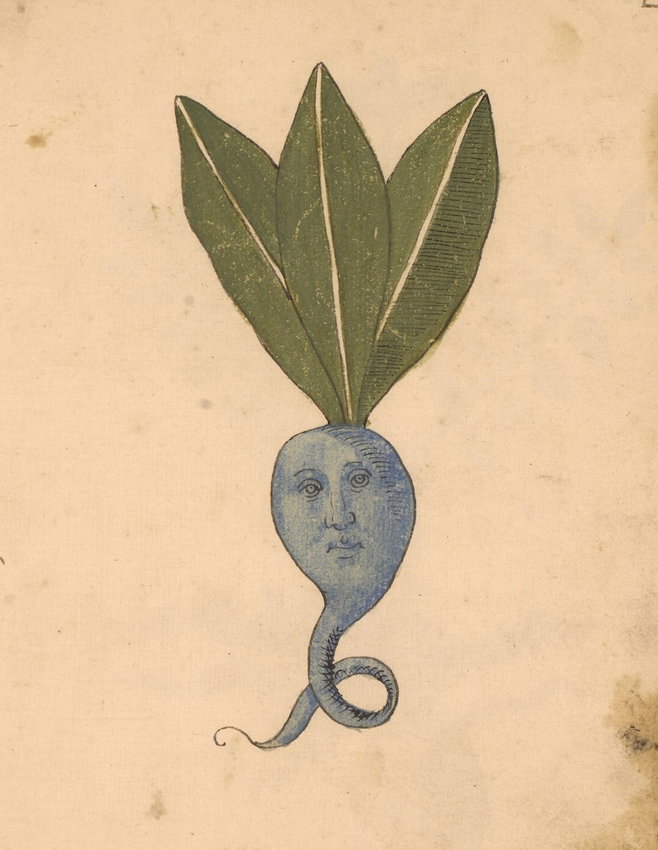
Erbario, 15th-Century Herbal. Via: Public Domain Review. Source: Penn Libraries.
At the most recent Transmission in Motion seminar, “Humor and Truth-Telling,” Dick Zijp brought Donna Haraway into dialogue with stand-up comedy. He juxtaposed her framework of situated knowledges, traditionally associated with scientific and ecological inquiry, with the deliberate construction of humor in performance. The parallel is striking. Much like scientists, comedians navigate complex entanglements, but they operate within a performative register that explicitly addresses an audience. This observation brought to mind how situated knowledges are often associated with the natural world: a dense network of relations and interconnections in which each being is unique yet linked to others. However, the natural world does not seem to tell jokes. Its truths arrive without timing or wit, yet they remain instructive.
In human-centered worldviews, plants and animals are often regarded as neutral or passive, whereas humor is seen as a distinctively human faculty. Comedians use timing and context to entertain while simultaneously revealing insights and critique. Nature, by contrast, acts without such deliberation. Extreme weather events illustrate this principle. Rivers overflow or dry up, trees shed or retain their leaves depending on heat or cold, and species face extinction as entire ecosystems respond to changes caused by human activity. Still, for the organisms themselves, no intention seems to be implied.
Viewing Zijp’s seminar through a Harawayan lens raises the question of whether we might read nature as a kind of truth-teller analogous to a comedian. Nature cannot craft jokes in a similar, intentional manner, but rather reveals insights through its entanglement and interaction. Such a perspective reframes our ethical and epistemic engagement with the more-than-human world. Climate crises and conservation are often approached with solemnity, which is appropriate given the gravity of these issues. However, attending to the unexpected and sometimes playful aspects of nature may cultivate a different form of attention. This attention can be serious without being oppressive, and engaging without being frivolous, fostering intrinsic motivation instead of solely relying on admonishment.
Just as comedians reveal truths through exaggeration and provocation, nature reveals truths through persistence and relationality. Both prompt reflection on our situatedness. In comedy, we observe performers negotiating with the audience; in nature, we recognize that we navigate systems beyond our creation, yet dependent on our participation. In this sense, both human and more-than-human actors function as situated knowledge hubs, offering insight through their positions within complex networks, albeit through distinct modes of expression.
Haraway’s concept of situated knowledge reminds us that every perspective is partial but meaningful. Humor can be a powerful tool for attending to these truths in ways that conventional seriousness cannot. It may bridge human understanding and more-than-human reality, as well as epistemic engagement and affective response. Nature may not tell jokes, but it instructs. Viewing the natural world through a light and playful lens may enhance our motivation to engage with climate and ecological challenges.
References
Haraway, Donna J. 1988. “Situated Knowledges: The Science Question in Feminism and the Privilege of Partial Perspective.” Feminist Studies 14(3): 575–599.