

Documentation
[TiM Recap] “Humour, Truth-telling, and Situated Knowledges” – Dick Zijp (Utrecht University) moderated by Theron Schmidt
by Tom Watkins
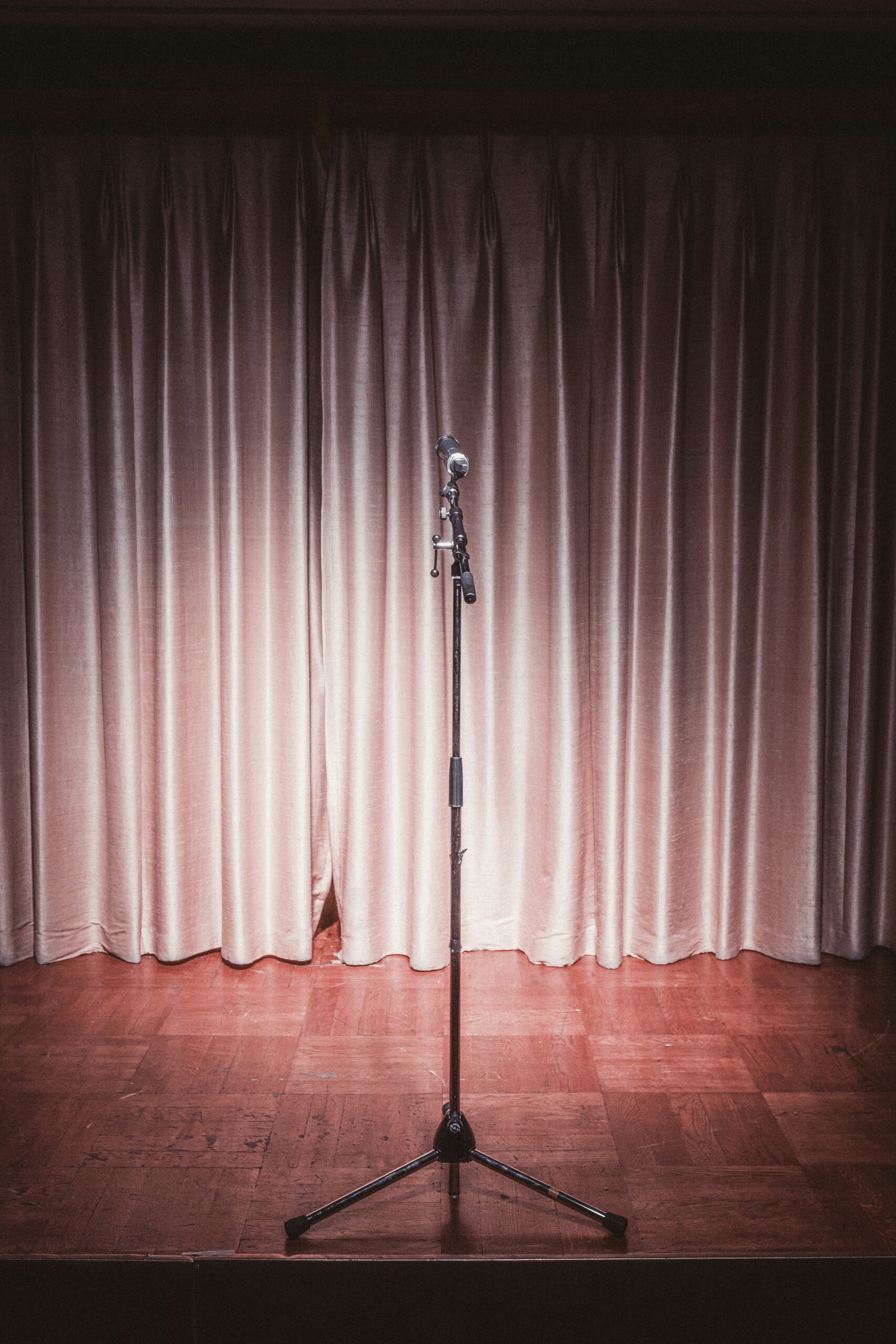
A microphone on stage under a spotlight during a stand-up comedy performance, representing a site where truth, humor, power, and audience negotiation converge. Photo by Samuel Regan-Asante on Unsplash.
During the seminar “Humour, Truth-telling, and Situated Knowledges,” Dick Zijp examined the idea that comedians function as “truth-tellers,” particularly within liberal frameworks of free speech. He questioned how humor comes to be understood as revealing truth in a “post-truth” political context, where satire is often positioned as an antidote to misinformation.
Stand-up comedy was described as grounded in experiential knowledge, with comedians speaking from lived experience. Zijp linked this to Michel Foucault’s concept of parrhesia, a form of truth-telling in which a speaker risks their position to confront power (Foucault 2011). However, he cautioned that applying this concept to contemporary comedy risks oversimplifying Foucault’s argument, particularly when such speech occurs from positions of institutional and cultural power. The lecture also engaged with theories of situated knowledge, suggesting that truth claims in comedy are partial and shaped by social position. While this offers a more grounded understanding of humor, it also raises the risk of relativism.
These tensions were explored through case studies of Theo Maassen and Dave Chappelle. In Maassen’s 2016 show From Bad to Worse, performed in the context of the Charlie Hebdo attacks, he attempts to construct a provocative joke about the Prophet Muhammad but ultimately does not complete it. Maassen is known for making jokes about a wide range of communities, positioning himself as an “equal-opportunity offender.” Zijp used this moment to show the limits of equal-opportunity offence in an unequal world. This reflects what Giselinde Kuipers describes as a “humor regime,” where norms about what can be joked about—and the expectations around how audiences should respond—are shaped by existing power relations (Kuipers 2011).
In Dave Chappelle’s The Closer (2021), Chappelle justifies jokes about trans people through his identity as a Black man. Zijp highlighted a moment in which Chappelle recounts Daphne Dorman’s statement—“I don’t need you to understand me… I am having a human experience”—to which Chappelle responds, “I believe you, because it takes one to know one.” He then follows this with a comedic turn, framing Dorman primarily as “one of us,” a comedian, which draws audience laughter. However, this shifts recognition away from the trans community toward a comedian-to-comedian relation, sidestepping broader critique. This dynamic reflects tensions within standpoint approaches, as discussed by Donna Haraway, where appeals to lived experience can function as authority while remaining partial and embedded in power relations (Haraway 1988).
The discussion that followed the seminar, focused on the limits of both liberal free speech frameworks and standpoint approaches. Participants questioned whether “speaking truth to power” remains meaningful when comedians operate within established media platforms. At the same time, concerns were raised about standpoint theory collapsing into relativism.
Further discussion addressed different modes of comedy, including transgressive and more contemporary forms that emphasize nuance over provocation. Participants also reflected on how media formats shape comedic practice, contrasting short-form content with longer stand-up specials. Finally, the role of audience interaction was discussed, particularly how comedians selectively engage audiences, shaping visibility and inclusion.
References
Foucault, Michel. 2011. The Courage of Truth (The Government of Self and Others II): Lectures at the Collège de France, 1983–1984. Edited by Frédéric Gros. Translated by Graham Burchell. New York: Palgrave Macmillan.
Haraway, Donna. 1988. “Situated Knowledges: The Science Question in Feminism and the Privilege of Partial Perspective.” Feminist Studies 14 (3): 575–599. https://doi.org/10.2307/3178066.
Kuipers, Giselinde. 2011. “The Politics of Humour in the Public Sphere: Cartoons, Power and Modernity in the First Transnational Humour Scandal.” European Journal of Cultural Studies 14 (1): 63–80. https://doi.org/10.1177/1367549410370072.