

Documentation
[TiM Recap] “From As If to What If: Simulation and Speculation in Contemporary Dramaturgy” – Liesbeth Groot Nibbelink (Utrecht University) and Sigrid Merx (Utrecht University)
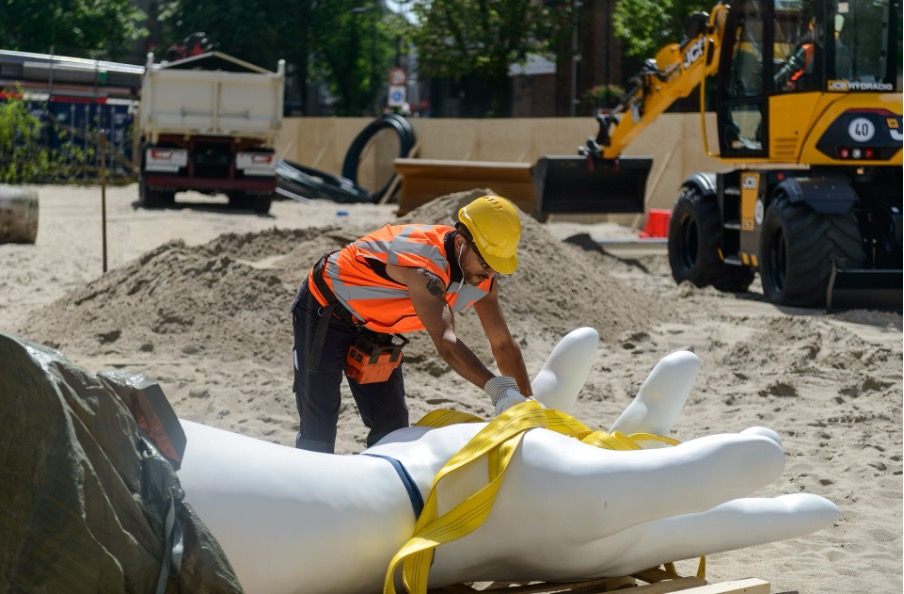
Dries Verhoeven, Sic Transit Gloria Mundi (2018). Photograph by Willem Popelier. Source: Dries Verhoeven.
by Jilke van der Kolk
Structure and Format of the Seminar
This seminar consisted primarily of a lecture-style presentation by Liesbeth Groot Nibbelink and Sigrid Merx, followed by an extended question-and-answer session with participants. The presentation offered a preview of their forthcoming book Simulation, Speculation and Futurity in Contemporary Dramaturgy: From ‘As If’ to ‘What If’ in European Performance Practice. The speakers structured their talk around four interconnected thematic sections, each addressing a key conceptual strand of their research. Visual materials, including video excerpts, supported several of the case studies discussed. The session concluded with a dynamic Q&A that encouraged extended reflection on the themes introduced during the presentation.
From “As If” to “What If” in Contemporary Dramaturgy
The first part of the session introduced the central conceptual movement of the book: the shift from “as if” to “what if” as twin dramaturgical inclinations in contemporary performance. The speakers described fiction and reality as deeply entangled modes of world-making. A key example discussed was Dries Verhoeven’s Sic Transit Gloria Mundi (2018), a project staged as a construction site dedicated to building a monument to a fallen Western male figure modeled after the artist himself. Although the monument was never completed, visitors could observe staged construction activities and even purchase miniature versions of the proposed statue. The work functioned simultaneously as fiction and as material intervention, reflecting broader geopolitical shifts such as the decline of Western hegemony. For the speakers, the project demonstrated how theatre increasingly operates outside traditional venues while still mobilizing theatrical conventions such as staging and audience framing.
The discussion also referenced works that deliberately disguise themselves as non-theatrical activities. One example was the political intervention by Theatre NO99, whose project Unified Estonia simulated the creation of a political party, employing theatrical techniques such as costumes and staged events. Similarly, Milo Rau’s The Moscow Trials reenacted legal proceedings related to the Pussy Riot case, framing theatre as a form of juridical inquiry. These projects illustrate how performance can infiltrate reality itself by mimicking institutional formats.
The speakers emphasized that many contemporary works shift from the performative logic of as if toward speculative what if practices. These works foreground futurity as something enacted in the present instead of as a distant utopia. Drawing on philosophical reflections by theorists such as Jacques Rancière and Jean-Paul Martinon, the speakers argued that fiction can function as a modeling tool, enabling artists to rehearse alternative social arrangements and possible futures.
Entangled Makers and Entangled Audiences
The second section focused on artistic research practices and the entanglement between artists, participants, and the research environments. According to the speakers, many contemporary performance makers engage in extensive research practices that extend beyond theatre by immersing themselves within the systems they study.
This approach was described through the concept of subversive affirmation, drawing on the work of Arns and Sasse (2006). Subversive affirmation involves mimicking systems so closely that their internal contradictions become visible. Such practices require forms of camouflage that allow critique to emerge from within.
One example discussed was Samira Elagoz’s Cock, Cock… Who’s There?, in which the artist adopted an alternate persona in order to interact with men in everyday settings. The project blurred distinctions between researcher and subject, illustrating how artistic research can become an embodied and relational process.
Another case involved a fictional retail environment selling soap intended to alleviate consumers’ sense of white guilt. Behind the humorous premise lay extensive legal and ethical research, demonstrating how performative interventions can compel audiences to confront their own complicity in systemic inequalities. The speakers described these practices as forms of prototyping, in which performances function as experimental models that can be tested and reconfigured over time.
Alongside these as if works, the speakers introduced what if practices that actively rehearse alternative forms of social interaction. The project Building Conversation by Lotte van den Berg was discussed as an example of performance as a space for “life exercises,” where new conversational formats are collectively rehearsed. Similarly, the participatory work Dying Together invited audiences to embody speculative disaster scenarios, fostering awareness of ecological interdependence and collective vulnerability. In these cases, performance becomes a space for prototyping social relations and experimenting with new forms of togetherness.
System Analysis and Critical Mimicry
The third section introduced system analysis as a dramaturgical strategy. Borrowed from interdisciplinary systems thinking, this concept enables artists to investigate interconnected social and institutional structures. Drawing on theories of complexity and cybernetics, the speakers emphasized that disorder and unpredictability are vital components of living systems. Artists, in turn, use mimicry to reproduce the logic of systems in order to expose their contradictions. This form of critical mimicry allows audiences to recognize systemic dynamics that might otherwise remain invisible.
A notable example discussed was the relocation of the white cube gallery format by the Congolese artist collective CATPC (Cercle d’Art des Travailleurs de Plantation Congolaise). In this project, plantation workers trained as artists created sculptures using cacao, a commodity historically tied to colonial exploitation. The sale of these artworks generated revenue that was reinvested into local land reclamation and agriculture. By replicating the aesthetic and economic logic of Western art institutions, the project exposed their colonial entanglements while simultaneously redirecting economic flows toward local communities. The speakers described this as a powerful example of performance operating as both artistic practice and socio-economic intervention.
Writing Together as an Entangled Practice
The final section addressed the collaborative writing process behind the book itself. The speakers framed their own writing as an example of entanglement, emphasizing how their distinct working methods shaped the final outcome. Groot Nibbelink described collecting extensive notes, references, and fragments across digital platforms, gradually building an interconnected network of ideas. While Merx described a more intuitive approach, allowing ideas to develop fully before committing them to text. Rather than dividing the book into separate chapters, they worked through ongoing dialogue, periodically meeting to exchange drafts and refine arguments.
This collaborative method required what they referred to as “conquered time”; dedicated periods away from daily obligations that allowed sustained focus and reflection. Over time, their individual voices became increasingly intertwined, making it difficult to distinguish authorship within the text. In this sense, the book itself emerged as a product of entangled intellectual labor.
Discussion and Q&A
The question-and-answer session extended the themes of the presentation by addressing historical context, unpredictability, research methodologies, and science fiction traditions.
One participant asked how contemporary practices relate to earlier experimental traditions from the twentieth century. The speakers responded that while their work acknowledges historical precedents, the book primarily focuses on contemporary practices shaped by current conditions of simulation, digital mediation, and geopolitical transformation. They emphasized that contemporary fiction operates within a media environment where distinctions between reality and simulation are increasingly unstable.
Another question addressed the role of unpredictability in performance. The speakers noted that many projects operate along a spectrum between controlled scenarios and open-ended processes. While some works are highly structured, they often incorporate moments where unpredictability is allowed, or even encouraged, to reveal the instability of systems.
Participants also asked whether artistic research necessarily produces measurable outcomes. The speakers suggested that research should be understood as an ongoing process rather than a fixed result. In many cases, the act of performing research itself generates knowledge, shaping both participants’ experiences and broader public understanding.
Further discussion explored the relationship between speculative dramaturgy and science fiction traditions. The speakers acknowledged that many of the works discussed engage with questions of survival, vulnerability, and collective futures. However, they also reflected critically on the limitations of their case selection, noting the predominance of European contexts and the need to engage more deeply with perspectives such as Afrofuturism.
The session concluded with reflections on hope and imagination as driving forces behind what if practices. The speakers described speculation not only as critical analysis but also as an invitation to imagine alternative ways of living together.
References
Arns, Inke, and Sylvia Sasse. 2006. “Subversive Affirmation: On Mimesis as a Strategy of Resistance.” In East Art Map: Contemporary Art and Eastern Europe, 444–455.
Rancière, Jacques. 2009. The Emancipated Spectator. London: Verso.