

Documentation
“Rehearsal for the Future” – Thorn Austin
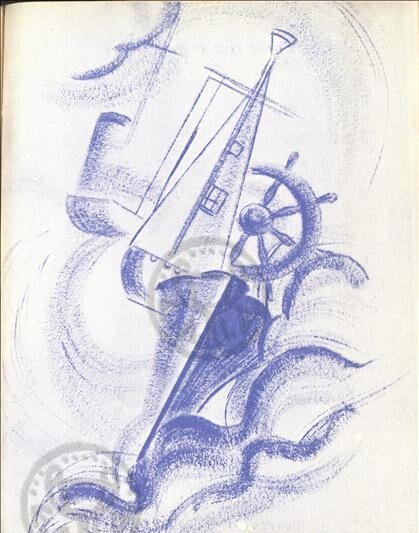
The Cain Mutiny trial by Diamantopoulos Vasilis – Hellenic Literary and Historical Archive – Cultural Foundation of the National Bank Of Greece, Greece. Source: Europeana.
Theatre and performance have always been a gathering space throughout many different cultures and times. This is because historically, theatre has worked as a force that connects people: whether for sharing knowledge between community members, rehearsing future life events or introducing others to a new idea. In this view, performances can be understood not just as ways to share knowledge but as active places where societal changes can form, especially within how we understand societal structures, build communities and create art. Theatre can help us uncover the past and the present, allowing us to explore systems of power and prominent ideologies. Theatre can also help us look to the future. Futurity means performing the future in the here and now or performing the future as if it already exists. The imaginary realm explores the constant creation of the world from past, present and future.
While today theatre is often used as system analysis in a form of critical mimicry, this idea is far from new. In 1722, while waiting for news from English King George II as to if he would pardon them for their pirating activities, Captain Thomas Anstis’s crew held multiple mock trials to try each other for piracy as a form of theatrical entertainment and to joke about fears which the dread would otherwise be overwhelming. As one ‘judge’ in these trials declared: “Thirdly, you must be hang’d, because I am hungry; that ’tis a Custom, that whenever the Judge’s Dinner is ready before the Tryal is over, the Prisoner is to be hang’d of Course. There’s Law for you.” (Johnson, Defoe, and Wetmore 1724, 388)[1]
The spectators are forced to identify themselves with the implications of the system but through a comedic and over the top format. Nowadays theatre practitioners are interested in becoming a part of a system to research from within to then critically examine and critique the system. Performances such as mock trials are utilized as a way to critique through replication or to imagine alternative social systems through simulations. This would be called a speculative practice: a rehearsal of the future.
References
Johnson, Charles, Daniel Defoe, and Alexander Wetmore. “Of Captian Anstis and His Crew.” In A General History of the Robberies and Murder of the Most Notorious Pyrates, with Smithsonian Libraries. London: Printed for, and sold by T. Warner, at the Black-boy in Pater-Noster-Row, 1724. http://archive.org/details/generalhistoryof00john.