
Documentation
“Phobiarama and the Discomfort of Real Fear” — Margot Van den Eeckhout
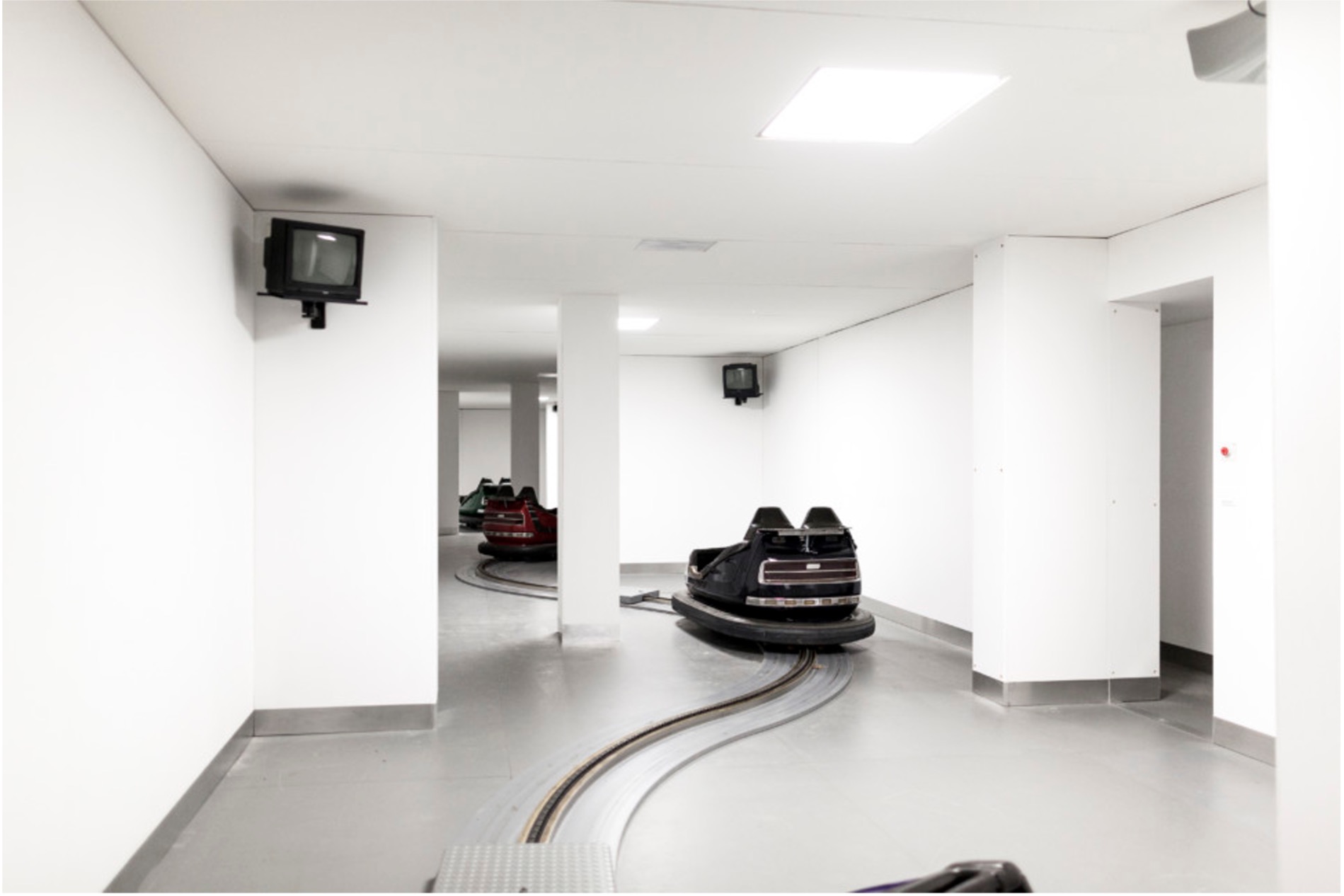
Dries Verhoeven, Phobiorama (2017-2018). Photograph by Thorsten Alofs. Source: Dries Verhoeven.
In line with the examples cited by Liesbeth Groot Nibbelink and Sigrid Merx during the discussion of their new book, “From As If to What If: Simulation and Speculation in Contemporary Dramaturgy”, I was reminded of Phobiarama by Dries Verhoeven. This performance does not simply present itself as something other than theatre. The performative installation offers a constructed experience that comes so close to reality that the distinction begins to lose its relevance. The performance simulates a situation in which the fears circulating in media and politics do not remain mere ideas, but are physically experienced. What if you don’t just hear about a threat, but begin to feel it, even in the absence of objective danger? What Verhoeven created with this work in 2017 is not an “as if” situation in which we temporarily believe in a fictional world. He built a theatrical haunted-house experience that produced real fear, based on real images, real political statements, and existing social tensions. These range from natural disasters to far-right ideologies and cultural stereotyping. Spectators were driven around in bumper cars, strapped onto a roller-coaster rail like in a theme park, within a carefully staged version of a reality we already know. Within this “as if” framework, as a spectator you know you are watching theatre, even when the form attempts to conceal it. The frame makes reflection possible: you can think, analyse, and position yourself. You are physically fixed in a bumper car, without control over your movement, while a stream of images and sounds directs you affectively. Fear arises here not because you necessarily believe something, but because of how the situation makes you experience it. What intrigues me is that this fear initially still feels playful, like in a haunted house, a controlled form of tension based on recognisable codes, but gradually this shifts. The fear becomes less entertaining and more connected to the reality outside the installation. The performers undergo a series of transformations from one costume to another (wolves, clowns), until all masks are removed and they present themselves as they are (broadly built, tough-looking men of colour). What could at first still be read as play suddenly becomes uncomfortably real. The work reveals not only the construction of fear, but also how those same mechanisms operate outside the theatre, through media and politics, among other things. In that sense, it aligns with “what if” thinking, it does not propose a hypothetical scenario, but compels us to feel a different question: what if the fear you experience here is exactly the same as the one guiding you outside this space? The fear that is evoked is not resolved within the boundaries of the performance. It lingers, because it is recognised, and because it already existed. Fear is not represented here, but transmitted.