
Documentation
“Inside the Model: Thinking Knowledge through the Orrery” – Jilke van der Kolk
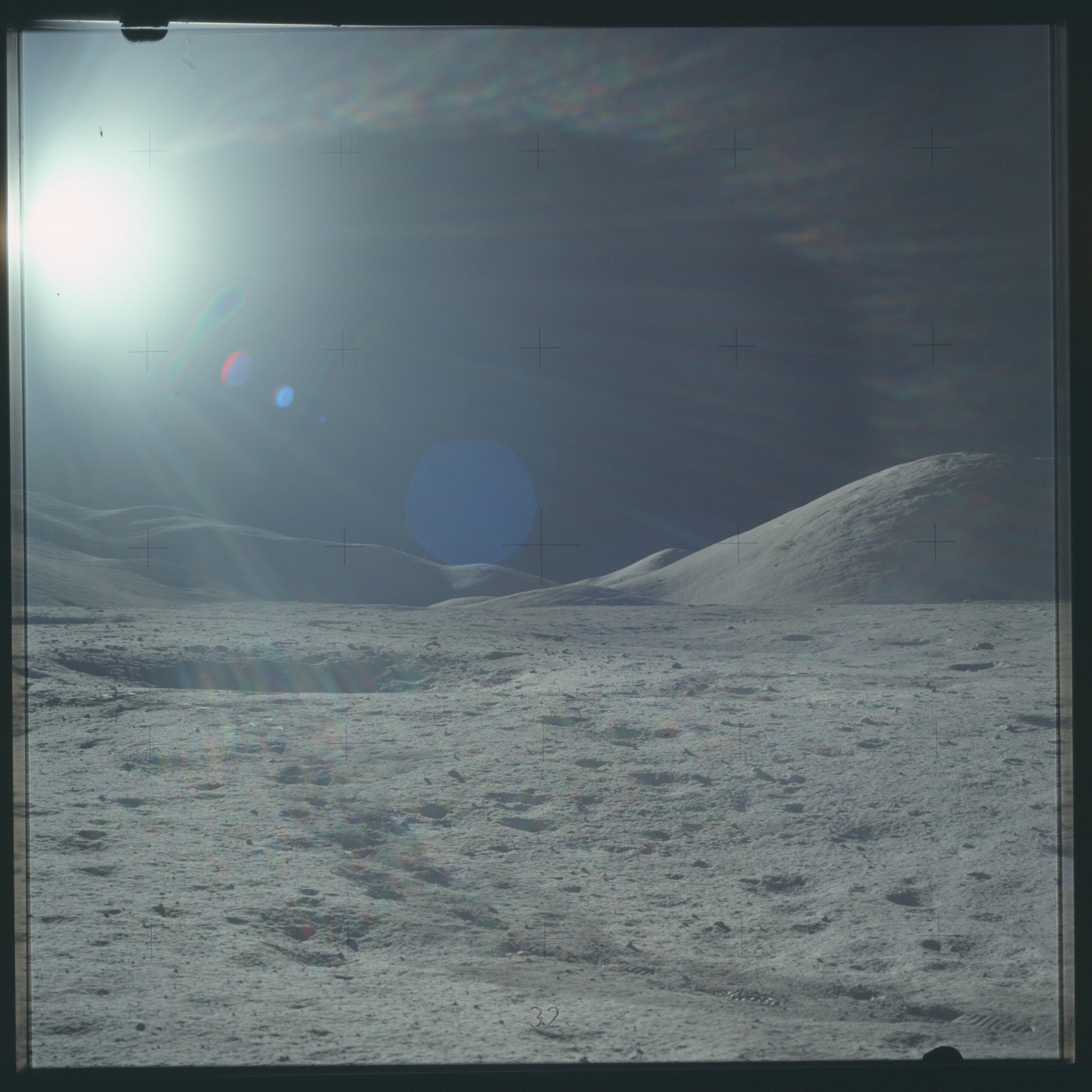
Apollo 17 Hasselblad image from film magazine 147/A – Rev12, EVA-1. 1972. Source: Flicker Project Apollo Archive
How can a tiny model of the solar system reveal the responsibility involved in knowing? This question stayed with me after the Transmission in Motion seminar on Theatre, Moon Studies, and Interplanetary Entanglements. Planetary knowledge is often imagined as distant, even though it is always grounded in specific materials and forms of mediation. Charles LeDray’s Orrery(1997) makes this visible in a striking way. It compresses the planetary system into something smaller than a human hand and builds this universe from human matter. Maaike Bleeker drew attention to this work in her reflections at the end of the seminar. She connected it to François Arago’s understanding of scientific instruments as active participants in producing knowledge. He argues that instruments shape what can appear and how it can be understood. The Orrery stages this openly. Its fragile proportions and its enclosure under glass resist any illusion of direct access to the cosmos. Time and motion are represented, yet they are also held still. The model invites imagination while revealing the choices that structure planetary relations.
What struck me most was how tightly the Orrery binds imagination to embodiment. Made from human bones, it places corporeality at the center of cosmic representation. The planetary system no longer exists only ‘out there,’ but is folded back into human substance. Drawing on Karen Barad, knowledge here is enacted through entanglement. Human matter and planetary motion circulate within the same object. The Orrery shows how the vast and the intimate meet in knowing. This carries ethical and political weight. Planetary systems are dynamic, yet our knowledge depends on stabilized representations. Models make relations visible, but they also shape what questions can be asked and what futures can be imagined. In the Orrery, the planetary system becomes something that can be held and observed within a fragile object. This changes how space is understood. The universe appears as something that can be ordered and cared for through human making. The stillness of the model suggests that planetary motion can be paused for reflection or intervention. In this way, the Orrery frames the cosmos as something that enters human responsibility through representation. It shows that every model already carries an idea of how humans relate to what is shown.
During the seminar, discussions of space colonialism and planetary governance returned to the problem of distance. When outer space is framed as remote, extraction and ownership can appear detached from responsibility. The Orrery unsettles this logic. It shows that responsibility is already present in the conditions through which planetary knowledge is produced. Knowledge does not arrive first, followed later by ethical concern. Responsibility is embedded in the very form through which knowledge becomes possible. Ultimately, LeDray’s Orrery shows us that knowing the cosmos involves responsibility. Each act of representation shapes how we imagine our place within it.
References
Barad, Karen. 2007. Meeting the Universe Halfway: Quantum Physics and the Entanglement of Matter and Meaning. Durham: Duke University Press.
Bleeker, Maaike. 2025. Reflections on Transmission in Motion: Seminar on Theatre, Moon Studies, and Interplanetary Entanglements, Utrecht University, December 3, 2025.
LeDray, Charles. 1997. Orrery [mechanical model]. Private collection.
Tresch, John. 2007. “The daguerreotype’s first frame: François Arago’s moral economy of instruments.” Studies in History and Philosophy of Science Part A 38(2):445–476. https://doi.org/10.1016/j.shpsa.2007.03.003