

Documentation
“Imagining Otherwise”—Margot Van den Eeckhout
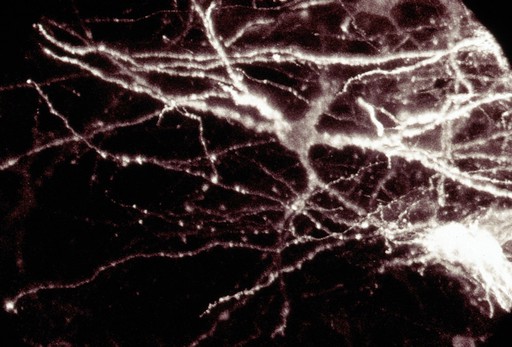
Interneurons. by Biosciences Imaging Gp, Soton – Wellcome Collection, United Kingdom. Source: Europeana.
Discussions of neurodiversity often revolve around recognition and representation. Institutions ask how neurodivergent people can be accommodated for example, and researchers investigate how neurological differences can be better understood. While these questions are undoubtedly important, they still tend to position neurodiversity as an existing condition that requires special management, explanation, inclusion… The approach presented by Shy*play seemed to move in a different direction. Guided by the question “What can neurodiversity do?”, their practice foregrounds storytelling, improvisation, and experimentation as methods for imagining alternative futures. Rather than beginning with diagnosis, they begin with possibility.
This shift reminded me of a broader tendency within performance studies and speculative artistic research. Increasingly, artists and scholars are interested not only in critiquing existing realities but in rehearsing different ones. Theatre has long functioned as a space where audiences temporarily inhabit alternative worlds. Speculative dramaturgies similarly ask not what is, but what might be. The value of such practices lies less in prediction than in their ability to make different futures thinkable. Seen from this perspective, fabulation becomes a political act. It allows participants to step outside dominant narratives that define neurodivergence primarily through deficit, productivity, or medical diagnosis. Instead of asking how neurodivergent people can fit into existing social structures, fabulation asks what social structures might emerge if neurodiverse ways of sensing, communicating, and relating were taken as starting points. Since most institutions are designed around assumptions of standardization. Standard ways of learning, communicating, working, and participating. Neurodiversity, however, exposes the limitations of these assumptions. It reveals that what is considered ‘normal’ is often simply what institutions have been designed to accommodate. Fabulation offers a way of imagining institutions differently. Instead of asking how neurodivergent individuals can adapt to existing structures, it invites us to imagine structures that emerge from a plurality of cognitive and sensory experiences. This raises the question about the role of cultural institutions. What responsibilities do theatres, museums, universities, festivals, etc have in supporting such practices? Whilst inclusion is often framed as opening existing spaces to marginalized groups, but perhaps that form of inclusion is not enough. Maybe institutions should also become spaces where alternative modes of perception and sociality can actively shape the conditions of participation themselves.
The notion of ‘neurodiverse futurities’ therefore feels relevant far beyond neurodiversity. At a time when many (social, political, technological, ecological) futures are presented as inevitable, fabulation offers a reminder that futures remain open. They can be contested and imagined otherwise. In that sense, to me, the most valuable takeaway from the session may not have been an answer at all. It was an invitation to keep asking what becomes possible when different ways of thinking and relating are the starting point.
References
Arribas Aion and Nestel Antje. “A Neurodiverse Fabulation: Techniques for Neurodiverse Futurities.” Transmission in Motion, seminar session, Utrecht University, June 9, 2026.