
Documentation
“From As If to What If to Activate Hope in and for the Otherwise-Possible” — Ani Encheva
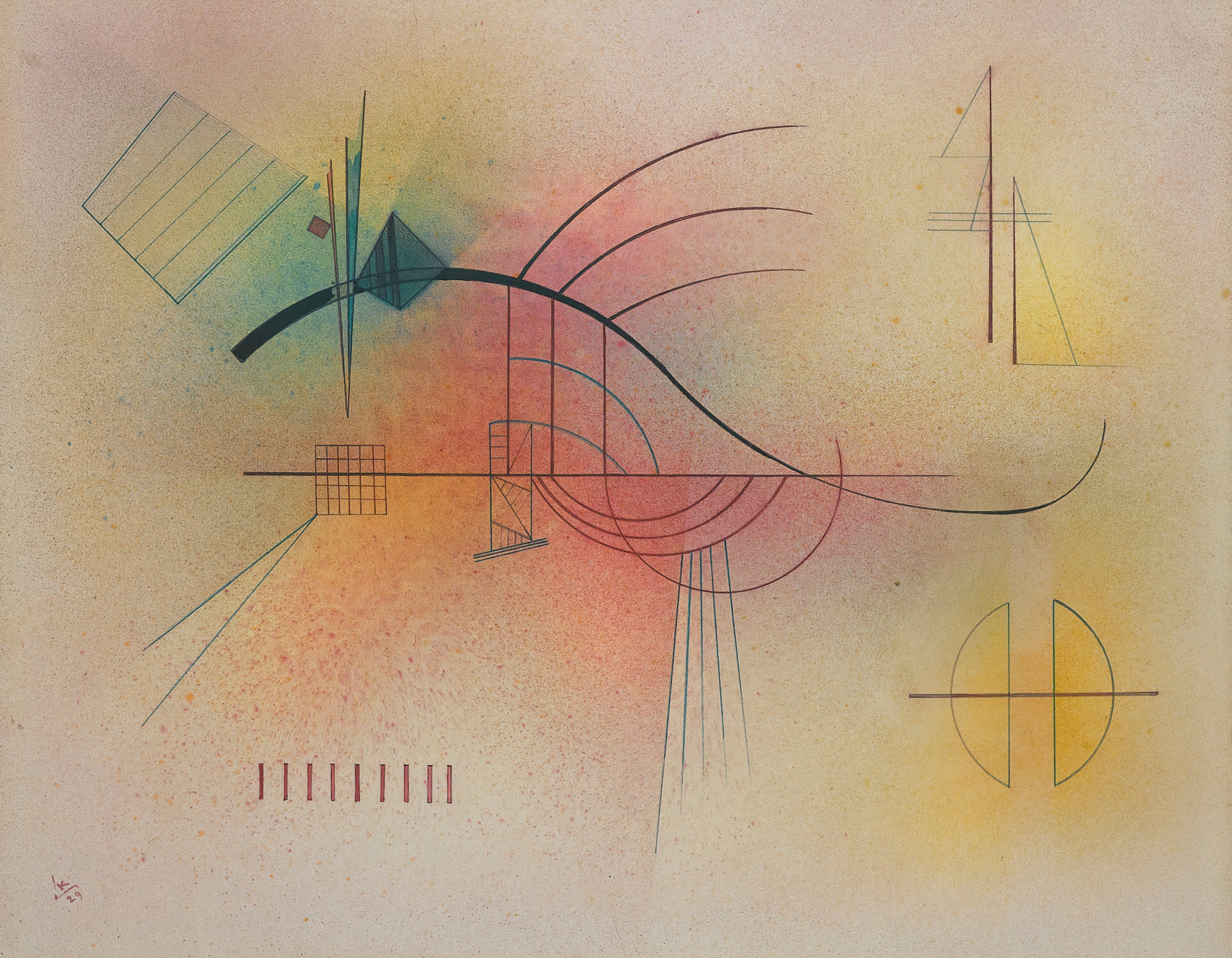
Kandinsky, Wassily . 1929. Linie (Line). Source: Artvee.
From the as if of the staged world toward the posing of what if questions about that world and other possible worlds – this was the journey that the audience was taken on during the Transmission in Motion seminar “From As If to What If: Simulation and Speculation in Contemporary Dramaturgy” led by Dr. Liesbeth Groot Nibbelink (UU) and Dr. Sigrid Merx (UU). Within this movement from as if toward what if, Groot Nibbelink and Merx proposed that the future world being staged or performed within the space of theatre is no longer situated in a yet-to-come, no longer “lying dormant somewhere in the future” (Martinon 2005), but instead begins to be rehearsed in situ. Through this in-situ rehearsal, the staged or performed world starts to take shape within the conditions of the present moment, becoming “concretely acted out or taking place here and now with every human gesture” (Martinon 2005).
Reflecting on the proposition that every imaginative act enacted through staging or performance simultaneously constitutes an act of actualizing a world in the here-and-now prompted me to consider the broader implications of this movement from as if to what if, not only within contemporary dramaturgical practice but also across other artistic, cultural, and educational spaces and contexts. If the contours of imagined worlds can begin to materialize within the present rather than merely pointing toward a distant elsewhere or elsewhen, then the what if emerges as a radically propositional and productively destabilizing gesture – one capable of rupturing and intervening in the seemingly closed circuits of the present, as well as unsettling the presumed inevitability of particular future trajectories, opening them instead toward what might be otherwise-possible.
It is within and through these openings that the what if activates the imaginary realm in ways that enable a wider constellation of possible worlds to emerge while invariably remaining entangled with the world we currently find ourselves situated in. At the same time, this movement outward and back again – across temporal dimensions that project into the future and return to the present – allows the what if to become a way of reflecting upon, and perhaps shifting, our perception of and relation to the present world through the speculative contours of another one. To borrow from Ruth Levitas, the what if holds the potential of activating the feeling that “something’s missing,” and from within this sense of lack and longing, the otherwise-possible begins to materialize in situ in the here-and-now – not as a blueprint or prescription, but as an “expression of desire for a better way of living” (2003, 4), or more broadly, as an expression of an otherwise-possible way of living. In this sense, the what if becomes a means of stirring the imagination to dream beyond what is – and beyond what merely as if is – into a more experimental terrain filled with “what if’s, what could be’s, and what if we didn’t” (Veletsianos et al. 2024, 2).
Perhaps, then, to stage or perform the as if in order to ask the what if becomes a way of imagining and experimenting with alternative here-and-nows as speculative and provisional encounters capable of activating hope in and for the possible emergence of the otherwise-possible. At the same time, such encounters also open space for reclaiming agency – even if only imaginative agency – in the shaping of futures. Through the very act of staging, performing, and thereby rehearsing for what that otherwise-possible might be, the possible pathways through which such a future could begin to be stirred into existence also become more perceptible and start emerging through concrete individual and collective gestures that originate in the space where that world was staged or performed, yet hold the potential to extend beyond it.
References
Levitas, Ruth. 2003. “Introduction: The Elusive Idea of Utopia.” History of the Human Sciences 16 (1): 1–10. https://doi.org/10.1177/0952695103016001002.
Martinon, Jean-Paul. 2005. “Strategies of (In)visibility Numerous.” Transversal. https://transversal.at/transversal/1202/martinon/en.
Veletsianos, George, Shandell Houlden, Jen Ross, Sakinah Alhadad, and Camille Dickson-Deane. 2024. “Higher Education Futures at the Intersection of Justice, Hope, and Educational Technology.” International Journal of Educational Technology in Higher Education 21: 43. https://doi.org/10.1186/s41239-024-00475-0.