
Documentation
“Chipping Away at Institutional Brick Walls” — Ani Encheva
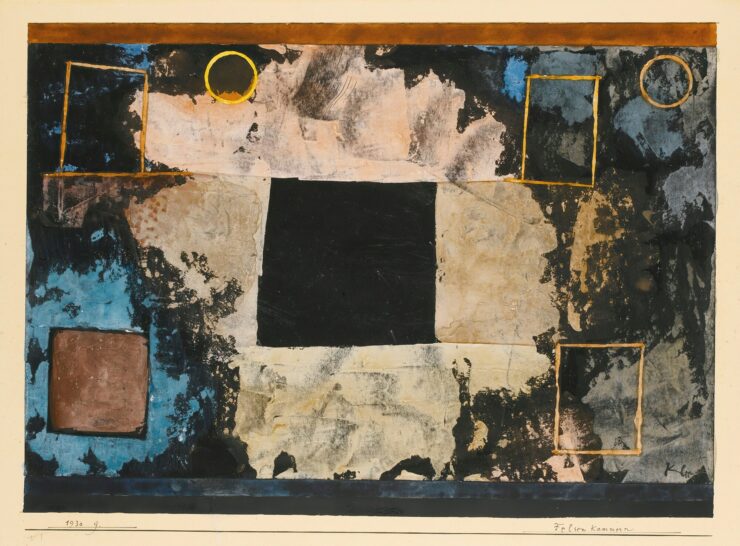
Paul Klee – Felsen Kammern (Rock-Cut Chambers) (1930). Source: Artvee.
How might neurodiversity be practiced intersectionally within educational, performing arts, and visual arts institutions? What “techniques of participation” – that is, techniques that seek to transform the processes through which body-minds are formed – might make it possible for neurodiversity to inhabit a space-time beyond the confines of neurotypical regimes? How might such techniques of participation, in turn, allow new narratives grounded in a “politics of togetherness-in-difference” to emerge? These questions and key phrases lay at the heart of the journey on which the audience was taken during the Transmission in Motion (TiM) seminar “A Neurodiverse Fabulation: Techniques for Neurodiverse Futurities,” led by Aion Arribas and antje nestel – co-initiators of the collective shy*play, whose participatory interventions explore neurodiversity’s potential to bring new formations of sociality into being.
The fabulation enacted by Arribas and nestel within the space-time of the seminar, together with the fabulations they had been cultivating through their work as part of shy*play, remained with me in the days that followed. In particular, I found myself traveling with their workshop Experiments for Neurodiverse Futurities (2024), in which they curated an environment for tracing ways of doing language beyond the written and spoken word through languages of movement, texture and shape, sound and vibration, and color. I also traveled with their performative events at PuntWG (2023), where they created a laboratory around a 300-metre-long entanglement of fabrics that acted at once as space-shifter, facilitator, and host. By bringing the fabrics into the space as a means of shifting perception and redistributing agency, shy*play sought to decenter both the assumption that a space must gather around a single center of attention and the idea that there is one prescribed way for a body-mind to move through that space and encounter other body-minds and more-than-humans.
As these fabulations travelled alongside me, they entered into conversation with the point of departure of this year’s TiM seminar, namely the question of how to navigate (institutional) entanglements. At that juncture, I began to consider how participatory interventions such as those developed by shy*play might become practices for unsettling the apparent solidity of institutional “brick walls,” to borrow Sara Ahmed’s vocabulary (2012). Ahmed argues that the institution – or that which has become institutionalized – is often encountered as a form of resistance against which one comes up precisely in the act of attempting to bring about change (2012, 26). It is in this very effort to transform what has become institutionalized that one becomes conscious of the “brick wall” – a barrier to change, a barrier to mobility of various kinds, and one that remains largely imperceptible to those body-minds who move freely through and within institutional spaces (Ahmed 2012, 174-175).
Ahmed proposes that “we might need to get in the way [of the wall] if we are to get anywhere” (2012, 187). Perhaps, then, one practice called for in the effort to navigate (institutional) entanglements is the sustained labor of “chip, chip, chip, chipping away” at the brick walls we encounter (Fitzgerald and Ahmed 2017). Such labor may be undertaken by those situated within the institution, as in the work of the diversity practitioners whose lived experiences Ahmed traces and who seek to transform the institutional spaces, routines, and norms that grant some bodies a more assured residence than others. Yet such labor may also take shape from the outside in, as the work of Arribas and nestel as part of shy*play demonstrates, through the crafting of participatory pockets of intervention in which neurodiverse forms of relating, doing, and being can be invigorated. Such pockets hold the potentiality not only to draw us toward alternative space-times capable of accommodating various body-minds, but also to cultivate practices of unlearning the neurotypical status quo whose persistence renders their creation both necessary and urgent in the first place. By chipping away at these walls, we may create cracks wide enough to loosen the entanglements that constrain us and, perhaps, begin weaving new, more pluralistic ones in their place.
References
Ahmed, Sara. 2012. On Being Included: Racism and Diversity in Institutional Life. Durham: Duke University Press.
Fitzgerald, Adam, and Sara Ahmed. 2017. “Sara Ahmed: ‘Once We Find Each Other, So Much Else Becomes Possible’: The Living a Feminist Life Author on Borders, Care, and ‘Being Diversity.’” Literary Hub, April 10.https://lithub.com/sara-ahmed-once-we-find-each-other-so-much-else-becomes-possible/.
Klee, Paul. 1930. “Felsen Kammern (Rock-Cut Chambers).” Artvee. Accessed June 15, 2026. https://artvee.com/dl/felsen-kammern-rock-cut-chambers/.